At corporate conferences around the world, business leaders hear the same alarming warnings repeatedly. Commentators show dramatic slides of international conflict, proclaim the arrival of a new Cold War, and declare the death of globalization.
The typical advice sounds simple and urgent: pull out of China, move manufacturing to Vietnam or Mexico, build redundancy across suppliers, and bring production back home.
While geopolitical friction is very real, applying these guidelines too broadly can severely damage a business.
At the Nordic Business Forum 2026, geopolitical expert, author, and professor Michael Beckley used his VIP session to examine those assumptions more critically. Rather than accepting them at face value, he argued for a more strategic approach: identify where geopolitical exposure truly threatens the business, then reduce the risk without undermining the economics that make the company competitive in the first place.
To thrive in today’s unpredictable environment, companies must replace panic with precision by developing a focused de-risking strategy.
What Is a De-Risking Strategy?
A de-risking strategy identifies the few geopolitical vulnerabilities that could seriously disrupt a business and reduces them without undermining the company’s competitiveness. Instead of attempting a total separation from volatile regions, an effective de-risking strategy isolates the specific components, suppliers, or processes that pose a genuine threat to business survival, managing those specific risks while accepting others.
The Hidden Traps of Indiscriminate De-Risking
Many consultants advise companies to adopt a “China-plus-one” model, or exiting China entirely to protect their operations. On paper, this sounds like a prudent move. In practice, it is incredibly complex and often counterproductive.
Modern products rely on hundreds of specialized components that are often produced more cheaply and efficiently in China than anywhere else. Forcing a company to buy inferior, more expensive parts simply to satisfy a geopolitical mandate puts the business at a severe competitive disadvantage.
Furthermore, true decoupling is rarely achieved. If a company moves its manufacturing to Vietnam or Eastern Europe, it frequently discovers that its new partners are Chinese-owned or entirely dependent on Chinese sub-components.
“You don’t have a China-plus-one strategy or a get-out-of-China strategy, you still have a China strategy just with more steps in it and at a lot more cost,” Michael pointed out.
The International Monetary Fund has found that indiscriminate diversification can double a firm’s operating costs while only reducing geopolitical exposure by roughly 40 percent. The solution is selective targeting.
“Instead of trying to maximize resilience across the board, you can just try to maximize your chances of survival given potential shocks that may come along.”
Leaders should identify the few critical components that could genuinely shut their company down for months, and brainstorm alternative plans exclusively for those items.
The Hidden Risk of Friendshoring
Another common trap is believing that moving operations to friendly or nearby countries automatically guarantees safety. While friendshoring and nearshoring are popular buzzwords, they come with their own set of significant challenges.
Leaders must remember that their competitors are receiving the exact same advice. When thousands of companies rush to relocate to the same alternative hubs in Mexico or Southeast Asia, it creates severe congestion. Land prices soar, energy costs rise, labor becomes scarce, and ports become overwhelmed.
Additionally, there is no such thing as a risk-free location. Regional grids can fail, new regulations can disrupt operations, and local political shifts can create unexpected hurdles.
“All of life is suffering. There is no non-suffering. You just have to choose which path of suffering that you want to take. It’s sort of like that with risk,” Michael observed. Executives must carefully weigh the secondary risks they are taking on when attempting to avoid primary ones.
Preparing for Supply Gluts Over Scarcity
The disruptions of the pandemic trained business leaders to fear supply shortages. As a result, many companies abandoned just-in-time delivery models and stockpiled massive amounts of inventory. However, Michael argued that the impending global threat is actually the exact opposite.
The world is facing an era of massive supply gluts. State actors are heavily involved in industrial policy, pouring trillions of dollars into subsidies for manufacturing. At the same time, rapid advancements in automation and artificial intelligence allow producers to move from prototype to mass manufacturing at unprecedented speeds. Compounding this issue is the reality of aging and shrinking societies, which leads to plateauing consumer demand.
“We talk a lot about supply security, but I think we need to also talk about demand security.”
When global markets are flooded with cheap, subsidized products, traditional manufacturing margins collapse. Companies must proactively find ways to protect their profitability by shifting their value proposition toward reliability, quality, and exceptional customer ecosystems.
Turning Geopolitics into an Offensive Advantage
It’s easy to view geopolitical turmoil purely as a tax on business that introduces tariffs, export controls, and expensive political games. But strategic leaders know that market distortions also create tremendous opportunities.
Government priorities can be more predictable than shifts in customer demand. Bureaucracies publish extensive white papers and five-year plans detailing exactly which industries they intend to subsidize and protect.
Proactive businesses can use this information to play offense. If a foreign government heavily subsidizes an industry, companies positioned downstream can secure incredibly cheap inputs. If a region implements strict tariff walls, organizations that secure an early foothold inside those borders can gain access to a partially protected market before competitors do.
Winning in a volatile global economy does not require perfection.
“When you’re running away from a bear, you don’t have to run faster than the bear, you just have to run faster than your friend,” Michael noted. A company simply needs to be faster and more adaptable than its direct competitors.
That relative advantage can come from many places. In Europe, for example, Michael pointed to deep human capital, robust infrastructure, political stability, and high-quality engineering as strengths that may become more valuable as artificial intelligence commoditizes routine answers.
The broader lesson is that geopolitical disruption does not affect every company or region equally. It creates new vulnerabilities, but also new pockets of advantage. Resilient leaders do not try to eliminate every risk. They identify the risks that truly threaten the business, understand where new opportunities are emerging, and adapt faster than competitors.
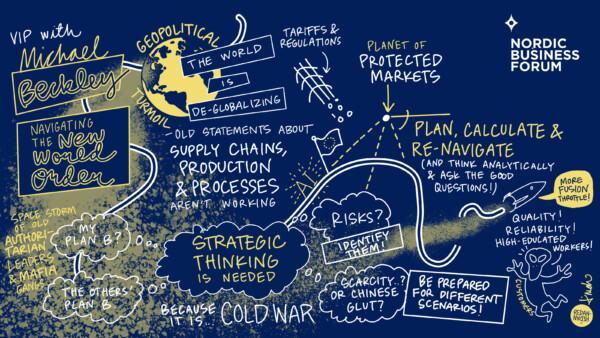
Visual summary by Linda Saukko-Rauta
Key points and Questions for Reflection
Key points
- Avoid indiscriminate decoupling: Cutting ties with efficient global suppliers indiscriminately doubles operating costs while providing minimal reduction in true geopolitical exposure.
- Beware of herd-mentality shoring: Rushing to the same alternative manufacturing hubs as your competitors drives up local land, labor, and energy costs while creating port congestion.
- Prepare for supply gluts: Massive state subsidies, rapid automation, and shrinking populations are flooding markets with excess goods, making demand security a top priority.
- Play offense with market distortions: Government industrial blueprints and infrastructure funding create predictable commercial demand for proactive organizations.
- Compete on reliability and trust: As manufacturing becomes commoditized, businesses can protect margins by offering exceptional quality, verified security, and reliable customer service.
Questions for Reflection
- Have you mapped out the specific 20 to 30 components that could completely halt your operations if a sudden geopolitical shock occurred?
- Are your alternative suppliers genuinely independent, or do they share the same hidden vulnerabilities as your primary sources?
- What secondary risks are you inadvertently taking on by moving operations to currently popular nearshoring or friendshoring destinations?
- How is your organization preparing to protect its profit margins if your industry is suddenly flooded with cheap, state-subsidized products?
- Where can your leadership team take an offensive approach by leveraging new government subsidies or trade protections to gain an advantage over competitors?