Why do so many great technologies never become great businesses? That was the question our Nordic Business Forum 2026 partner Berggren put on the table at the event’s Executive Cafe in September. The Nordics have strong R&D, skilled people, and plenty of ideas, yet too many innovations never reach scale.
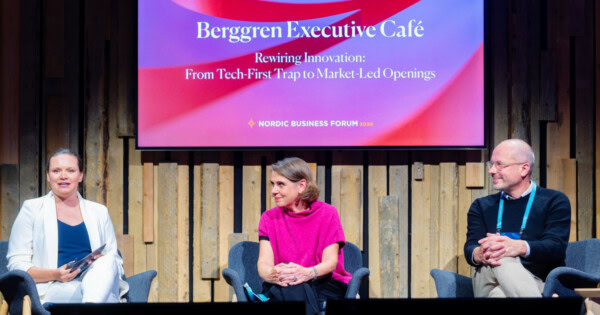
To explore this innovation-growth paradox, Mari Aulio, Head of Sales & Marketing at Berggren, was joined by two leading Finnish business thinkers: Elina Björklund, Chair of the Board at Reima Group, and Oskar Korkman, Co-Founder of Alice Labs Partners.
The session opened with five bold statements, and the conversation that followed offered a clear message for leaders: technology alone does not create growth. Market capabilities do, when they work together with technology and the ability to scale.
Why the Linear Innovation Model No Longer Works
In Finland especially, the dominant thinking has been to invest heavily in R&D first, develop something new, and only then figure out how to commercialize it. According to Oskar, this model is outdated for a simple reason: it doesn’t work. When you look at the fastest-growing companies in the world, most of them are not built on commercializing inventions.
Oskar described the develop-first, sell-later approach in direct terms: “It’s a slow and non-functioning paradigm.”
He used AI as an example. Finland tends to approach AI through deep tech and deep science, while fast-growing Swedish companies such as Lovable and Legora did not invent AI. They saw an application area and turned existing technology into real market value.
“Innovation doesn’t always need to have actual new technology. It’s also about combining resources in new ways and that’s innovation”, said Oskar.
The Innovation Triangle: Technology, Market, and Scale
Instead of a linear pipeline, Elina offered a different picture. Imagine a triangle with scaling capabilities and capital at the top and technology capabilities and market capabilities at the two bottom corners. True innovation is born only in the center, where all the three capabilities meet.
Both Elina and Oskar agreed that the key is to work on all three at once. Elina also made an important clarification: market capabilities are not the same as sales and marketing. They describe an organization’s ability to see, understand, operate in, and create new markets.
One of the most memorable examples came from Reima. When the company started making school backpacks for children, its product process was so technically driven that the team ran the same abrasion resistance tests they used for snowsuits and pants. “No one actually thought that maybe kids don’t slide on their backpacks, but they use their pants.” The organization did its very best to create the technically best product, while something else would have mattered more to the end user.
Ambition too often means technological ambition, while sometimes a less technical solution creates more value for the customer.
Put the Customer in the Middle and Work Backwards
So what does this look like in practice? Elina shared how Reima turned its process from inside-out to outside-in. Earlier, product development started from sales figures and what sold well last year. The new process started from the end user, before R&D even began. The team created a persona of a Norwegian father buying products for his children and gave him a name, which made it easier to keep the real end user in mind, not only the retailers and distributors.
The process change had three practical elements:
- All functions at the table from day one, including people who understand consumers, not only engineers.
- One owner for the go-to-market process who keeps the milestones on track.
- A consumer theme to kick off every R&D cycle, based on what is happening in people’s lives.
Elina was honest about the challenges. Sales often loses some power in this shift, as other functions get a stronger voice. “Might sound chaotic. And it is chaotic in the beginning, but when you get the organization to think in that way, it is a huge relief.”
Market Capabilities Belong in the Boardroom
Oskar defined market capabilities as the strategic ability to sense markets and understand their dynamics, also outside your own industry, so you can see what is happening in society and how it trickles down to your business. Most importantly, it means acting on those insights: questioning assumptions and configuring resources accordingly. He called it a general growth leadership skill and “almost like a meta skill for the future.”
This is why both Elina and Oskar want market capabilities on the agenda of leadership teams and boards, not only insight or marketing departments. In Finland, Oskar noted, market-related work has often been pushed down to an operational level, while leadership has favored people who are strong with numbers and technology.
Elina agreed: “market capabilities are not about sales and marketing. It’s strategic leadership.”
Timing is part of this skill too. Elina admitted that a smart activity sensor Reima developed for children’s clothing came two or three years too early for the market.
They both highlighted also the importance of bringing the issue of bridging this cap to a national agenda. The skills and knowledge needed for navigating the market needs and finding and understanding the opportunities require a structural shift in how we equip the future entrepreneurial minds.
Not a Zero-Sum Game: Building Market Capabilities Across the System
None of this means technology matters less. Oskar was clear that strengthening market capabilities doesn’t mean neglecting technical ones. “It’s when these come together where the magic happens.” Elina added that Finland’s competitive edge will most likely continue to come from technology, and combining it with stronger market capabilities is a winning formula.
Because the challenge is cultural and systemic, Elina and Oskar called for a national agenda involving companies, education, and institutions. Elina also had encouraging words about funding: “the good news is that no extra money is needed.” Part of Finland’s existing R&D investment could be redirected to market insight at the start of the pipeline, not at the end.
Oskar also challenged a familiar phrase. He suggested we stop saying that Finland is good at innovation but bad at commercializing it: “We are not good at innovation if we are not having growth and value creation in the market.”
To wrap up the discussion, Mari from Berggren reminded leaders that IP and technical potential only create value when they find a market. The way forward is to build both.