For decades, global business operated under a comforting assumption: tomorrow will inevitably be better than today. That optimism was grounded in reality. From the mid-20th century until recently, the global economy experienced an unprecedented surge in wealth, cross-border trade, and living standards.
In that environment of rapid growth, strategic missteps were easily forgiven. When the entire economic pie is expanding, running a profitable company is far more straightforward.
That historic party is drawing to a close. Around the world, the economic boom is slowing, debts are climbing, populations are aging and shrinking, and the globalization that once lowered costs is splintering into regional trade barriers and conflict.
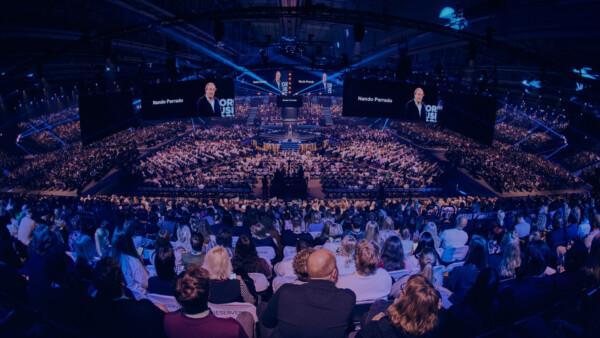
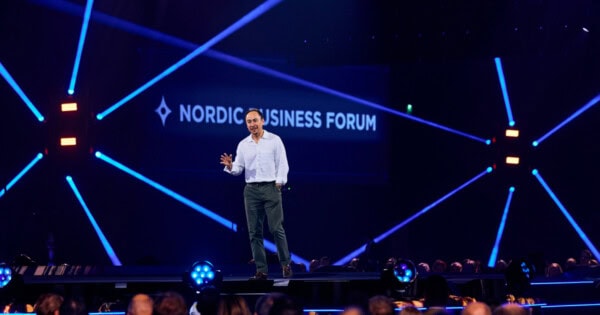
At Nordic Business Forum 2026 in Helsinki, geopolitical expert, author, and professor Michael Beckley delivered a shrewd assessment of this new reality. His talk laid out why the era of easy growth has ended, how economic slowdowns spark geopolitical friction, and what business executives can do to build resilience in a more fragmented world.
What Is the End of Easy Growth?
The end of easy growth is not a routine cyclical downturn or the fault of a single political figure. It is a long-term economic shift known as secular stagnation.
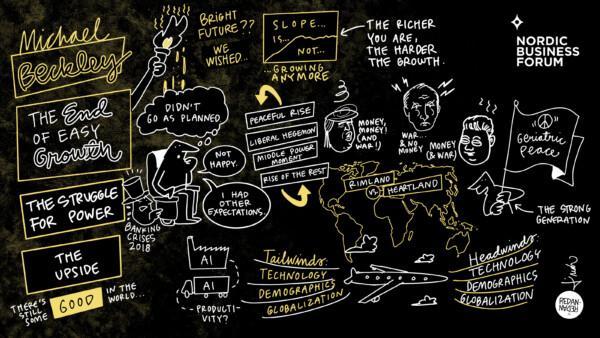
The postwar economic miracle relied on three powerful, temporary tailwinds that have now transformed into structural headwinds:
- Transformative Technology: Industrialization and the initial harnessing of fossil fuels reshaped human society, introducing railroads, electricity, modern sanitation, and indoor plumbing. Those advances doubled human lifespans and yielded massive productivity leaps. By comparison, recent digital tools, while impressive, offer more incremental productivity gains because the low-hanging fruit of modern industrialization has already been picked.
- Demographic Expansion: In earlier decades, growing populations brought millions of young workers, consumers, and taxpayers into the economy every year. Today, two-thirds of humanity lives in countries with birth rates below the replacement rate. The ratio of active workers supporting retirees has plummeted from over ten-to-one to just two or three in several major economies, squeezing labor supplies and public budgets.
- Hyper-Globalization: The rollout of container shipping, open trade pacts, and the fall of Cold War barriers allowed businesses to stitch together global supply chains and access cheap labor pools worldwide. Today, international trade is increasingly restricted by tariffs, industrial subsidies, and geopolitical tensions.
Michael noted that if the average growth rates between 1990 and 2007 had held steady after 2008, people worldwide would be 10% to 40% richer today. To sustain even modest growth amidst demographic decline, organizations must either demand longer work hours or increase annual productivity by 1% to 5% every year, which is rarely sustained outside of post-war reconstruction.
Why Economic Stagnation Triggers Global Conflict
When people expect constant upward mobility and suddenly face stagnation, they do not treat it as stability; they experience it as a painful personal loss.
In behavioral psychology, this dynamic is explained by loss aversion and reference dependence: individuals feel the pain of a loss far more intensely than an equivalent gain. When paychecks flatten and buying a home becomes unaffordable, citizens look for someone to blame.
This frustration fuels domestic political division, pitting workers against employers, renters against owners, and generations against one another. Politicians often capitalize on this resentment, building support by identifying domestic or foreign scapegoats.
The exact same logic operates among nation-states. When leaders in autocratic nations, such as Russia or China, realize their domestic economic momentum is fading, their risk tolerance shifts.
“Growth is getting harder, but coercion may be getting easier.”
If a state fears it will be weaker tomorrow than it is today, the temptation rises to make an aggressive grab for land, market control, or vital supply chains right now.
Following the 2008 financial crash, Russia’s economic stagnation contributed to a shift from diplomatic engagement to revanchist aggression, ultimately culminating in the full invasion of Ukraine. Similarly, China responded to slowing growth by channeling immense state subsidies into industrial sectors like semiconductors, batteries, and electric vehicles while expanding its military presence across Asia.
The Squeeze on Middle Powers and Global Business
During the peak of globalization, businesses and mid-sized nations enjoyed a flexible environment. They could source raw materials anywhere, manufacture where labor was cheapest, and sell to both Western and Eastern markets without picking sides.
Today, great powers are placing their markets, technology, and alliances behind paywalls. The United States increasingly demands that partners buy American, restrict advanced technology sales to adversaries, and accept tariffs if they want access to its domestic market. For its part, China uses state subsidies and raw material monopolies to force dependencies on its trading partners.
This dynamic leaves middle powers and international companies caught in the middle. While specialized companies possess valuable niche technologies, such as semiconductor manufacturing or critical mineral processing, those assets rarely function without access to larger American software ecosystems or Chinese refining facilities. Playing both sides has become risky, exposing international firms to unexpected sanctions, export bans, and political scrutiny.
Will Artificial Intelligence Save Economic Growth?
Many business leaders look to artificial intelligence as the silver bullet that will reverse economic deceleration. While AI offers tremendous utility, Michael cautioned executives against expecting instant macroeconomic transformations.
“Reorganizing our entire economy around AI is going to take time. And until that happens, our extraordinary AI is going to keep running into ordinary bottlenecks.”
An advanced AI design system still requires concrete, structural steel, electrical transformers, and skilled construction crews to build a factory. An automated distribution order still travels in a conventional truck over aging physical highways. Furthermore, many critical modern challenges are constrained by physics, engineering, and political friction, rather than raw computing power.
Michael noted that human beings remain the ultimate general-purpose technology. While robots excel inside controlled assembly lines, the messy real world of construction, healthcare, education, and executive leadership demands human judgment, dexterity, empathy, and improvisation.
The Upside
While navigating a slower, more confrontational world will be challenging, Michael argued that there are still strong reasons for long-term optimism:
1. The Mobilization of the Rimland
History shows that whenever an authoritarian continental power attempts to dominate Eurasia, coastal democratic nations form an opposing coalition. Today, across the “Rimland”, which spanns North America, Europe, Japan, and regional allies, democratic nations are rearming, rebuilding manufacturing, securing supply chains, and strengthening defense networks. Together, they command significantly greater economic, military, financial, and technological resources than Russia, China, Iran, and North Korea.
2. Autocratic Overreach
Aggressive expansion comes at a high cost. Russia has weakened its long-term economic potential through war, while China faces mounting debt and demographic decline. Sustaining militarized economies will eventually force difficult trade-offs.
3. The Geriatric Peace
Aging societies are less inclined toward prolonged conflict. Older populations shrink military recruitment pools while directing more public spending toward healthcare, pensions, and domestic stability.
4. Generational Resilience
Modern societies have access to clean water, advanced medicine, satellite networks, and global logistics systems that past generations could only have imagined. For Michael, that extraordinary capacity is reason for optimism.
“The world is getting more dangerous. We have to be real about that. But we have never been in a better position to deal with danger. We are the strongest, most capable generation that has ever walked this Earth.”
Key points and Questions for Reflection
Key points
- The era of easy growth is over: Structural factors, including slowing productivity, rising debt, and demographic contraction, are creating prolonged secular stagnation.
- Reversed tailwinds shape the economy: Transformation through basic industrialization, population booms, and frictionless trade have given way to bottlenecks, aging workforces, and protectionism.
- Loss aversion fuels global friction: When societies expect rising standards but experience stagnation, frustration triggers populist politics and aggressive foreign policies.
- Middle powers face alignment pressures: Great powers are putting access behind economic and security paywalls, making corporate neutrality difficult to maintain.
- Physical constraints limit digital gains: AI will boost efficiency, but economic growth remains tied to physical infrastructure and labor constraints.
Questions for Reflection
- How reliant is your current business model on open global trade, and where are your supply chains vulnerable to new tariffs or trade barriers?
- How are you preparing your company to handle shrinking labor pools and an aging workforce in your core markets?
- If easy market growth cannot be assumed over the next five years, what specific productivity improvements will drive your profitability?
- What physical bottlenecks in infrastructure, energy, or materials could slow down your digital or AI initiatives?
- How can your leadership team build financial and operational buffers to withstand sudden geopolitical shifts?