Every leader understands the feeling of stepping into a room or answering a phone call when high-stakes tension fills the air. A critical deal collapses, an employee underperforms, or two key executives lock horns over strategy. When these moments occur, the default corporate reaction is often avoidance or confrontation.
Many leaders believe good communication is about delivering flawless presentations, issuing firm directives, or maintaining an air of unshakable confidence. At Nordic Business Forum 2026 in Helsinki, Alison Wood Brooks offered a radically different perspective on interpersonal dynamics. Alison is an associate professor of business administration at Harvard Business School, where her research focuses on the science of conversation and behavioral negotiation.
Her message for executives was direct: conversation is not a solo performance. It is a game of complex coordination played across multiple minds. When leaders master the science of handling difficult conversations, they stop letting emotional tension derail their operations and learn to transform conflict into collaboration.
Why Difficult Conversations Go Wrong
To understand why challenging discussions often go wrong, Alison pointed to a famous quote by playwright George Bernard Shaw:
“The greatest failure of communication is the illusion that it has taken place.”
In communication science, humans consistently overestimate their ability to connect. Research conducted at the University of Chicago asked participants to interpret common statements. Participants believed their listeners understood their intended meaning 85% of the time. In reality, listeners were correct only 44% of the time.
This dynamic creates a significant hazard for senior executives. When leaders deliver instructions or discuss sensitive feedback, they assume their message landed with perfect clarity. But their team members frequently leave with a completely different impression, quietly creating misaligned expectations and costly operational errors.
Furthermore, every conversation involves competing internal priorities. Alison introduced the Conversational Compass, which maps goals along two different axes:
- Informational goals: Balancing accurate information exchange with the need to protect sensitive data, maintain privacy, or exit a meeting smoothly.
- Relational goals: Balancing personal self-interest and organizational targets with care, empathy, and respect for the other person.
When these goals collide, such as balancing candor and kindness during tough performance reviews, internal tension rises. Psychologists describe the “red zone” as a state of increased physiological activity, marked by reactions such as a racing heart, sweaty palms, stress, anxiety, fear, or anger. In that state, negative emotions can easily derail productive dialogue. Skilled conversationalists know how to stay in the “green zone,” keeping their emotions from interfering with their ability to address the issue at hand.
The CALM Framework for Mastering Difficult Conversations
Difficult conversations are high-stakes interactions shaped by conflicting goals, opposing viewpoints, emotional vulnerability, and uncertainty. They arise in moments such as performance reviews, critical feedback, negotiations, and team disagreements. Handled poorly, they trigger defensiveness and damage relationships; handled skillfully, they clarify expectations, build trust, and create space for better decisions.
To help business leaders navigate high-stress discussions without damaging relationships, Alison shared a tactical four-part framework known as CALM. This framework provides practical tools for staying grounded in the green zone of clarity and connection.
C: Confirm Understanding
Never assume your conversation partner has fully grasped your meaning. Skilled conversationalists confirm understanding in nearly half of their speaking turns by using specific verbal habits:
- Paraphrasing: Use phrases like, “What I am hearing from your side is…” to demonstrate active listening before offering a solution.
- Affirming: Acknowledge points of shared agreement out loud, validating valid concerns even when you disagree on the final outcome.
- Asking repair questions: Do not hesitate to ask clarifying questions such as, “When you mentioned that delay, did you mean the vendor timeline or internal testing?”
A: Admit Uncertainty
In executive boardrooms, leaders often adopt an attitude of performative certainty, believing decisiveness is the best way to persuade others. Behavioral science reveals the opposite: listening to rigid, performative certainty makes people defensive.
Certainty rarely persuades. Instead, using hedging language like “I wonder if,” “It might be that,” or “I might be wrong here” creates psychological safety. When leaders openly admit what they do not know, they give others permission to share their knowledge gaps, opening the door to genuine collaborative problem-solving.
L: Learn By Asking Questions
Human beings are the only species on Earth capable of asking questions. However, in high-pressure workplace meetings, leaders frequently become what Alison calls “zero-questioners,” issuing directives without asking for input.
The type of questions you ask matters greatly:
- Avoid accusatory “why” questions: Questions like “Why did you miss that deadline?” feel like attacks and immediately provoke defensive excuses.
- Use open-ended “what” questions: Reframing the issue into questions such as, “What were the roadblocks in your workflow this week?” invites constructive information without triggering hostility.
- Lean into follow-up questions: Follow-up questions are the ultimate antidote to superficial conversations. They prove that you are genuinely listening, which builds rapport across sales negotiations, investor meetings, and performance reviews.
Alison’s message was simple: leaders learn more when they ask more.
“Don’t leave a conversation being a zero-questioner.”
M: Make It Human
Every difficult workplace discussion must preserve the dignity and humanity of the people involved. Alison examined an interaction where real estate entrepreneur Ryan Serhant had to dismiss an agent who had compromised a major deal.
Throughout that difficult conversation, Ryan remained calm, asked thoughtful questions, and reaffirmed his respect for the employee as a person, saying he believed the individual would have a great career, just not at that company. Maintaining genuine respect and care makes even hard organizational separations constructive rather than destructive.
Conversations Are the Operating System of Business
Every professional relationship is simply a sequence of conversations accumulated over time. In an illustration of “closeness lines,” every interaction forms a knot along a string. Some knots pull people closer together, while others push them apart.
“The easy conversations come first. The easy conversations, the knots on the strings, precede the difficult ones. We build our conversation skills in the easy ones.”
That is why everyday interactions matter. By spending time together, exchanging ideas, sharing a laugh, and simply connecting, people build both trust and conversational skill. Those easier moments prepare relationships to carry the weight of harder conversations involving disagreement, accountability, pressure, or change.
And this extends far beyond individual relationships. Every organization is made up of repeated conversations between colleagues, leaders, customers, partners, and the outside world. In that sense, dialogue is the operating system of a business: it shapes how people connect, collaborate, and navigate difficult moments when the stakes are high.
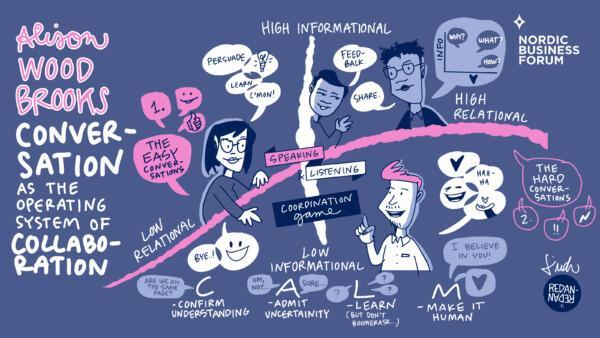
Visual summary by Linda Saukko-Rauta
Key points and Questions for Reflection
Key points
- The illusion of understanding is common: People assume listeners understand them 85% of the time, while actual comprehension hovers near 44%.
- Performative certainty blocks agreement: Admitting knowledge gaps and using modest hedging language encourages reciprocal honesty and unlocks genuine persuasion.
- “What” questions outperform “why” questions: Asking open-ended what questions uncovers rich information without making the recipient feel interrogated.
- Follow-up questions build strong relationships: Asking meaningful follow-up questions signals genuine curiosity and drives successful negotiations and team reviews.
- Easy conversations build a foundation for tough ones: Establishing mutual trust during routine daily exchanges ensures your team can withstand high-stakes feedback when challenges arise.
Questions for Reflection
- Where in your organization are leaders letting the illusion of understanding create costly operational misunderstandings?
- Do you enter difficult conversations with an attitude of performative certainty, or do you have the courage to admit what you do not know?
- How often do you find yourself asking accusatory why questions instead of curious, collaborative what questions?
- Are you or your managers guilty of “boomer-asking,” where a question is used merely as an excuse to redirect the focus back onto yourself?
- How can you help your leadership team practice the CALM framework during internal reviews and cross-functional meetings this month?