For decades, the standard corporate playbook on sustainability treated responsibility as an exercise in damage control. Companies established dedicated corporate social responsibility (CSR) departments in the basement, produced glossy annual reports, and set incremental targets to reduce carbon emissions or plastic packaging by a few percentage points.
Leaders congratulated themselves on doing less harm. Yet as planetary boundaries are pushed to their breaking points and social inequalities deepen, an uncomfortable truth has emerged: being less bad is still bad.
At Nordic Business Forum 2026 in Helsinki, Paul Polman delivered a direct challenge to senior business leaders. As the former CEO of Unilever, co-author of the bestselling book Net Positive, and one of the world’s foremost advocates for sustainable enterprise, Paul spent a decade proving that businesses can decouple financial growth from environmental impact. Under his leadership, Unilever delivered a 300% shareholder return while establishing social and environmental sustainability at the heart of every brand.
His message to executives was uncompromising: incremental improvement is no longer enough. Companies must move beyond compliance and damage reduction and rethink their role as active contributors to a healthier society and planet.
What Does It Mean to Be Net Positive?
A net positive company is an organization that thrives by giving more to the world than it takes. Rather than focusing merely on reducing its negative footprint, a net positive enterprise actively restores, renews, and repairs the natural environments, communities, and stakeholders it touches.
Paul exposed the logical flaw at the heart of traditional corporate social responsibility: doing less harm is not the same as creating a positive impact. Incremental improvement can still leave the underlying system fundamentally damaging.
“I used to kill 10 people. I was a great murderer. Now I only kill 5 people. I’m still a great murderer. This is exactly what we’re doing. We’re fooling ourselves.”
To determine whether an organization has crossed the line into true responsibility, Paul urged leaders to test their strategies against two simple questions:
- Are we profiting from solving the world’s problems, or are we creating them?
- Is the world better off because my company is in it?
Any economic system where too many people feel excluded or left behind will eventually rebel against itself. The rising populism and social discontent visible across modern democracies are direct symptoms of that imbalance.
Businesses cannot remain healthy bystanders in societies that are failing.
The Economics of Action: Turning Cost into Opportunity
Many executives hesitate to pursue aggressive sustainability goals because they view them as an unaffordable operational expense. When business challenges emerge, sustainability is often the first budget item postponed.
Paul pointed out that this perspective misunderstands modern market reality. In almost every industry, the financial cost of inaction has surpassed the cost of action.
Negative externalities across global food and land-use systems cost society roughly $12 trillion a year, while shifting to regenerative agriculture would require only several hundred billion dollars annually.
Similarly, the world spends roughly 10% to 12% of global GDP on conflict prevention and wars, often linked to the failure to address underlying environmental and social pressures. Paul noted that this is roughly three times the amount needed to implement all of the Sustainable Development Goals.
Financial markets are beginning to reflect this shift. Over time, indices of businesses operating in the green economy have consistently outperformed traditional, fossil-heavy sectors. Capital follows risks and returns, and investors are increasingly reluctant to bet on companies built for an extractive past that the planet cannot sustain.
“Cost is now the tipping point,” Paul explained. In markets like the United States, states expanding renewable energy are already seeing lower energy prices and greater energy independence.
For Paul, sustainable transformation is not a philanthropic exercise. It is one of the largest commercial opportunities of our century.
Five Principles of Courageous Leadership
Transitioning to a net positive model requires more than good intentions. It requires bold personal conviction and systemic courage.
Paul outlined five core operating principles that define courageous, future-fit leadership:
1. Take Responsibility for Your Total Impact
Organizations frequently believe they can outsource their supply chain and simultaneously outsource their moral responsibility. If your products contribute to deforestation, unfair labor practices, or water scarcity several steps down the value chain, that is your business.
“When you break it, you own it, you fix it.”
True leadership means owning your entire operational footprint.
2. Set Science-Based Targets to Win
Too many corporate targets are designed simply “not to lose”. Teams look at past performance, calculate what feels safe, and propose goals they already know how to reach.
Real ambition requires setting targets based on what science and planetary boundaries demand, even if you do not yet have all the answers. Acknowledging that you need help builds authentic trust with partners and employees.
3. Embed Purpose Across the Entire Strategy
Sustainability cannot remain an isolated initiative run by a public relations team in the basement. It must be integrated into capital allocation, research and development, compensation, and every individual business unit.
When sustainability is peripheral, companies quickly retreat whenever external political or market pressures arise.
4. Practice Radical Consistency
“Trust comes on foot and leaves on horseback,” Paul warned. Employees, customers, and investors closely monitor how organizations behave when trade-offs arise.
A company cannot claim to be a climate leader while funding industry associations that lobby against environmental standards, or celebrate inclusion while relying on aggressive tax avoidance structures. Consistency across public advocacy, tax contributions, and internal pay ratios is the foundation of institutional integrity.
5. Collaborate Deeply
The scale of modern systemic problems makes individual corporate action insufficient. Solving challenges like ocean plastic, deforestation, or agricultural wages requires leaders to unite with direct competitors.
“When it gets to the future of humanity, we should not compete, we should cooperate.”
Tipping points do not require consensus from every business on earth. Uniting 5% to 15% of the key players across an industry is often enough to shift the economics of an entire supply chain permanently.
The Duty of the 5%
Reflecting on his upbringing in the Netherlands, Paul shared the story of his father, whose education was disrupted by World War II. His father worked double shifts in a factory to ensure his six children received an education, demonstrating the core principle of leadership: putting oneself in the service of others.
For business executives attending the Nordic Business Forum, that obligation is especially clear. Having stable shelter, access to education, financial security, and executive authority means having won what Paul described as the “lottery ticket of life”.
Those fortunate enough to sit in the top 5% of global society have a moral duty to place their talents, capital, and companies in service of the remaining 95%.
By leading with purpose, demanding accountability, and collaborating boldly across industries, business leaders have the power to create a regenerative economy that ensures shared prosperity for generations to come.
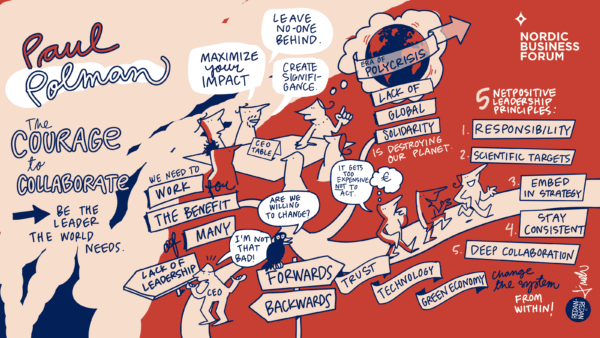
Visual summary by Linda Saukko-Rauta
Key points and Questions for Reflection
Key points
- Doing less bad is insufficient: Incremental reductions in harm still deplete social and natural capital; companies must adopt restorative, net positive business models.
- Net positive businesses give more than they take: Long-term success depends on whether a company helps solve the world’s challenges rather than contributing to them.
- Inaction costs more than action: The economic damages of climate disruption and social breakdown far outweigh the investments needed to build sustainable systems.
- Accountability spans the entire value chain: Leaders must own the social and environmental consequences of their suppliers, operations, and products.
- Deep collaboration creates tipping points: Uniting 5% to 15% of industry players is enough to transform systemic supply chains and regulatory environments.
Questions for Reflection
- If your company vanished tomorrow, would the world be genuinely better off or worse off without it?
- Where is your organization settling for being “less bad” instead of pursuing truly regenerative or restorative solutions?
- Is sustainability embedded in your core capital allocation and executive incentives, or is it managed as an isolated communications project?
- Do your company’s corporate lobbying activities and trade associations fully align with your stated organizational values?
- Which competitors could you invite to the table this year to solve a shared systemic challenge across your industry?