Most business leaders believe that their company’s success depends on discovering one genius strategy, creating a groundbreaking product, or executing flawless multi-year roadmaps. Yet in a fast-moving world where technology, consumer behavior, and markets shift constantly, traditional strategic planning often fails.
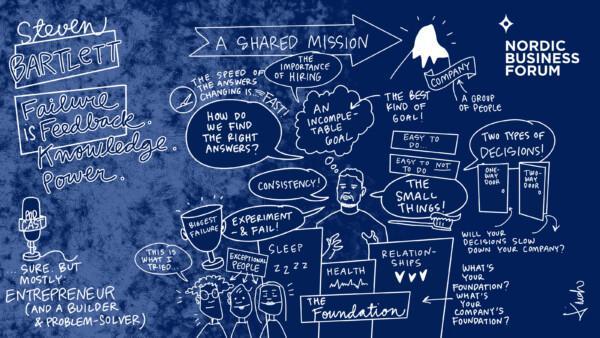
In a moderated session at Nordic Business Forum 2026 in Helsinki, entrepreneur, investor, and host of the renowned podcast The Diary of a CEO Steven Bartlett explained what drives high performance. Drawing on his experience building and scaling companies, Steven argued that long-term success does not require superhuman intellect or sophisticated theories.
Instead, he made the case for a much less glamorous but far more powerful formula: think long term, obsess over small gains that compound over time, and build a culture of experimentation where failure becomes a source of actionable knowledge.
Why Long-Term Thinking Changes How You Lead Today
Most modern corporations are trapped in the short-term. They plan from quarter to quarter, measure progress by immediate metrics, and push teams to hit short-lived targets. Steven believes that the real magic in business happens when you radically extend your time horizon.
Steven illustrated this idea with a simple thought experiment. Imagine, he said, that I gave you an unlimited number of bricks and just one minute to build the tallest possible tower. You would probably stack them vertically as fast as possible, creating something tall but fragile enough to collapse with a gust of wind. But if I gave you one year, your approach would change: you would lay them horizontally and build strong foundations.
“The only thing I changed was the time horizon. And in doing so, what changed is your behavior today,” Steven explained.
For leaders, adopting a long-term approach means setting “incompletable goals.” A goal that can be completed, like hitting a specific revenue target, can leave you without a sense of direction once it has been achieved. When Steven decided to view The Diary of a CEO as a 50-year commitment, it changed his daily choices. He stopped chasing high-profile celebrity guests who did not genuinely interest him and focused entirely on deep, authentic conversations that he and his listeners could value for decades.
Failure Is Not the Enemy, Guesswork Is
In the corporate world, failure is often something to avoid or hide. Leaders can spend months debating an initiative in an effort to prevent a single mistake. Steven argued that this gets business backwards.
“Failure was my feedback. Feedback is knowledge. And knowledge is power. So really, failure is your power.”
Companies like Amazon and Booking.com have embraced structured experimentation. Amazon’s failures, from the Fire Phone to Endless.com, were outweighed by successful bets like Amazon Web Services (AWS). As Steven put it, “The 1 in 10 pay for the graveyard.”
Booking.com took a similar approach, building an experimentation platform that allowed real customer behavior and not boardroom debate to provide answers.
This kind of first-party experimentation matters because external knowledge quickly loses its edge. Testing hypotheses directly in your market allows you to discover what works before your competitors do.
The Power of the 1% and Psychological Momentum
When organizations attempt to innovate, they often focus exclusively on massive, dramatic breakthroughs. They overlook the tiny details because they seem inconsequential. Steven shared that some of the greatest competitive advantages come from doing the hundreds of small, petty things that other companies ignore.
The success of The Diary of a CEO is not simply the result of Steven asking better questions. Behind each conversation lies an obsession with testing hundreds of seemingly insignificant variables that range from monitoring carbon dioxide levels in the studio, knowing that high concentrations can impair cognitive performance, to researching the music guests listened to in their youth so they feel at ease from the moment they enter the room.
Focusing on the 1% does something even more important: it creates psychological momentum. Citing cycling coach Sir David Brailsford and research from Harvard Business Review, Steven explained that human motivation does not come from massive annual goals. It comes from the feeling of forward progress. When team members achieve and celebrate small daily wins, their sense of momentum and energy skyrockets.
How to Build a Culture of Experimentation
Many leaders want to encourage innovation, but their corporate environments discourage teams from trying anything new. When surveyed in real time, audience members pointed to fear, bureaucracy, and hesitation as the primary killers of new ideas.
To overcome this, Steven outlined practical leadership principles to make experimentation safe and systematic:
1. Fix Your Incentive Structures
“Sane, rational people do not act outside of their incentives,” Steven stressed. If bonuses and promotions only reward successful projects, employees will only propose safe, predictable bets. In an experiment, the outcome is uncertain by definition. Leaders must measure and reward the inputs, meaning the number of attempts made and hypotheses tested, rather than whether an experiment succeeded or failed. In Steven’s businesses, teams share their hypotheses and failed tests openly on Slack, and a weekly trophy is awarded to whoever failed the most.
2. Differentiate Between Reversible and Irreversible Decisions
Borrowing from Jeff Bezos, Steven emphasized the difference between Type 1 and Type 2 decisions. Irreversible choices (one-way doors), like large structural company shifts, require deep analysis and deliberation. Reversible choices (two-way doors), such as testing a marketing campaign or tweaking a workflow, should be made immediately.
“The cost isn’t being wrong. The cost, as all of you will know, is the corporate procrastination where you waste nine months getting to the yes,” Steven noted. Failing quickly in a single week is far cheaper than spending nine months waiting for legal, procurement, and management approvals.
3. Communicate Through First Principles and Stories
When driving change or introducing new initiatives, leaders often communicate instructions as top-down personal opinions, creating resistance. Effective leaders start with agreeable foundations: core truths that everyone on the team accepts. By walking teams through the logic and the human story, team members naturally reach the same conclusion, turning compliance into genuine motivation.
Hiring: The First Foundation of Business Success
As an early-stage entrepreneur, Steven believed business success came from his own hard work and personal intelligence. Over time, his perspective shifted entirely.
“Everything in your business, all of those problems I was mentioning earlier, are downstream from a human being’s brain. That is the first foundation of business. It is the brains you assemble and the culture you bind them together with.”
Persuading exceptional talent to join your company is not about offering the highest salary. Drawing from conversations with intelligence officers, Steven highlighted the power of deep listening. Most people rarely experience someone listening to them without interruption for ten minutes.
When leaders give candidates the space to speak about their background, their doubts, and their personal aspirations, candidates reveal their internal ideology and the unfulfilled parts of their hero’s journey. True alignment happens when your company’s mission becomes the missing puzzle piece that helps them climb their personal Everest.
Key Points and Questions for Reflection
Key Points
- Long-termism dictates current behavior: Extending your time horizon from quarters to decades changes how you lay foundations and protects your business from sudden disruptions.
- Experimentation kills guesswork: In a rapidly changing market, competitive answers expire quickly; running continuous first-party tests is the most reliable way to find what works.
- The 1% compound into massive advantages: Great execution lies in hundreds of small details that competitors dismiss as petty.
- Progress drives human motivation: Celebrating small daily wins builds psychological momentum and keeps teams engaged.
- Every business problem is downstream from hiring: Your organization’s outcomes are determined by the quality of minds you bring through the front door.
Questions for Reflection
- If you set a 50-year horizon for your organization, what projects or habits would you stop doing today?
- Does your current bonus and recognition structure reward the courage to test new ideas, or does it quietly penalize failure?
- What are three “small things” in your customer experience or team workflow that everyone overlooks because they seem petty?
- Which decisions currently sitting in committee reviews are reversible two-way doors that your team could test this week?
- How much time each week do you personally invest in listening to exceptional talent to understand their personal goals and values?