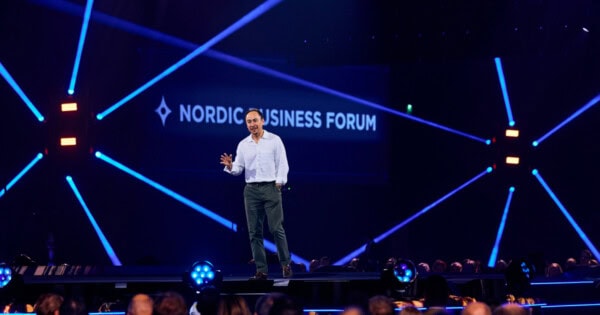
At Nordic Business Forum 2025, our theme is “Moving Forward”—an exploration of what it takes to lead through complexity, seize opportunity, and shape the future with intention.
We asked our speakers before the event:
“In your experience, what distinguishes leaders who successfully drive progress from those who struggle to adapt?”
Their answers revealed distinct but interconnected themes. Below, we share their perspectives grouped into core qualities that define forward-moving leadership.
1. Thinking Long-Term
Leaders who focus only on short-term wins often sacrifice sustainability. Those with a broader horizon build resilience and outlast their competition.
Simon Sinek:
“Some leaders work hard only to drive short-term progress. However, an excessive focus on short-term results almost always comes at the cost of long-term success and stability. These leaders struggle most to adapt when their progress slows…or even declines. They continue to apply more pressure to drive short-term results, which does even more damage to the long-term viability of the organization. The best leaders have an Infinite Mindset. Ironically, it is the long-term focused companies that, over time, tend to outperform their short-term obsessed competitors.”
2. Embracing Risk and Uncertainty
Navigating change demands boldness. Successful leaders don’t just manage risk—they leverage it to unlock new possibilities.
Peter Hinssen:
“I think that the idea of weaponizing uncertainty and understanding risk, leveraging the potential of the never normal, that for me is the absolute characteristic of companies and individuals who can move forward.”
Jonah Berger:
“In terms of what distinguishes leaders who successfully drive progress from those who struggle to adapt, I think it’s the ability to deal with change. Being a good leader always requires dealing with uncertainty and figuring out how to manage through it. How do you help teams move forward in uncertain environments? How do you help them change from one course of action to another? And adopt new strategies, even when the outcome isn’t completely uncertain. I think good leaders understand how to motivate their teams and how to drive action by harnessing the power of change.”
3. Resisting the Pull of Comfort
Progress often means disrupting what’s already working. Courageous leaders challenge the status quo—even when things seem fine.
Diana Kander:
“I think it’s very important to understand the strong gravitational pull of the status quo, especially when we achieve success, how good it feels, and how comfortable it is.
Every dollar we make is a reason not to change anything because you don’t want to mess it up. And yet it is that comfort that sabotages our ability to move forward.
So what I try to do is shake myself out of that mindset of status quo thinking.”
4. Stay Open and Curious to the World
Adaptable leaders are outward-facing and curious. They keep their eyes open for inspiration, invite input, challenge the standard ways, embrace feedback, and think globally—knowing fresh perspectives fuel growth.
Rick Rubin:
“Progress is born from open-minded curiosity. Look to the new and novel, or the ancient past, but never the current accepted standard. Forward motion comes from the fringes. Challenge every assumption. Trust the mysterious sparks of intuition. The future is revolutionary.”
Milda Mitkuté:
“My answer would be openness to the world because the more closed and reserved you are, the less input from the outside world you can get, and the less input from the outside world you get, the more limited you are. You cannot take global decisions anymore, because you live in a very small world. I think that once we stay open always, that is what makes a difference between being local, small, compared to global and scalable.”
5. Leading with Empathy and Purpose
Leadership is not just about strategy; it’s about heart. The most impactful leaders put people first, communicate with clarity, and lead with authenticity.
Angela Ahrendts:
“In my experience, the leaders who truly move things forward lead with purpose, not ego. They stay open, embrace emerging technologies as enablers, and build cultures grounded in empathy and trust. The ones who fall behind are often those who resist change or focus too much on control — forgetting that progress is always powered by people.”
Gianpiero Petriglieri:
“I have found that when you ask people, ‘How do you know that someone is a good leader?’ they usually answer that they do not ‘know’ it. They feel it. Leaders move us, emotionally and practically. And they often do so because they are genuinely moved in turn, usually by a story that they are compelled to tell, to embody, and ultimately to build. A story of a better future for the group of people that they aspire to lead. So I think the most successful leaders are those who are moved by a clear story, show it, and understand who are the people that they want to move, and move forward with.”
6. Acting with Courage and Clarity
In times of complexity, forward-moving leaders take decisive action—even when perfection is out of reach.
Sukhinder Singh Cassidy:
“The leaders who successfully drive progress distinguish themselves by their ability to simplify complexity and rapidly bring clarity to what success, roughly speaking, looks like. They don’t wait for perfection but instead prioritize swift action, holding themselves and their teams accountable for moving sooner rather than later towards a goal. They understand that true progress is achieved through continuous iteration on a broadly defined thesis, which they will refine as they get proof points of success or learning directionally towards the goal.”
Risto Siilasmaa:
“I think we live at a pivotal time. There are significant seismic shifts happening due to technology, and we need to transform, and it will take courage. You can think all you want. You know what you need to do. But if you don’t have the courage to do it, then it’s all for nothing.”
7. Collaborating with Collective Intelligence
Today’s challenges are too complex for solo leadership. Progress requires humility, curiosity, and inclusive thinking.
April Rinne:
“It is leaders who are not afraid of not knowing, not having all of the answers, and are enough to recognize that the only way we get through this is together. And we need to build our collective wisdom and collective intelligence, and collective leadership muscle.”
Howard Yu:
“I think leaders who succeed are what I call focused, curious, calm, and creative. They would be willing to explore new solutions, explore a new world, but at the same time remain calm and stay focused on what truly matters.”
Join Us at NBF 2025
We look forward to welcoming you to Nordic Business Forum 2025 on the 24th and 25th of September, whether you’re joining us in person or online. Let’s explore what it means to truly move forward—together!