In business and in life, leaders often prepare for uncertainty by analyzing spreadsheets, consulting predictive algorithms, or building elaborate risk mitigation frameworks. Yet when a true catastrophe hits, balance sheets and forecasts cannot replace human character.
When familiar structures collapse and conventional odds fall to zero, what keeps a team alive, focused, and moving forward?
At Nordic Business Forum 2026 in Helsinki, businessman, entrepreneur, and author Nando Parrado answered that question through one of the most remarkable survival stories in human history. In October 1972, Uruguayan Air Force Flight 571, carrying an amateur rugby team and their families, crashed high in the freezing Andes Mountains.
For 72 days, facing temperatures as low as -30°C, devastating avalanches, starvation, and the end of official search efforts, Nando and his teammates survived against extraordinary odds.
His message to thousands of executives was a profound lesson in crisis leadership: when technology and external systems run out of answers, survival depends on deeply human capacities such as empathy, decisive action, mutual trust, and love.
Why Algorithms Cannot Replace the Human Edge
Nando began his keynote by reflecting on how modern technology views impossible scenarios. If artificial intelligence had evaluated the conditions of the fuselage in 1972, the conclusion would have been instant surrender. Survival experts worldwide agreed that young athletes from sea-level Uruguay, with no mountain gear, no food, and no winter training, could not survive 24 hours.
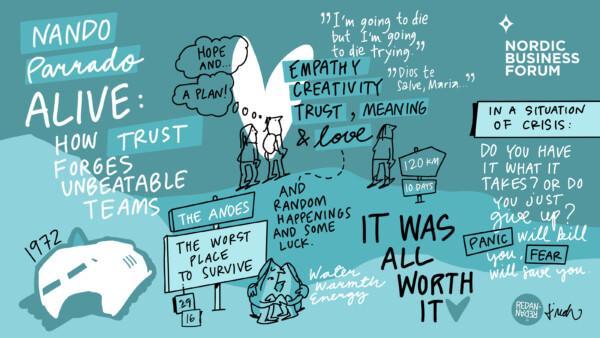
“If we would have put on ChatGPT and at that time all the information that we had about the problems we were having there, the answer would be very, very simple,” Nando said. “Lie down, stop breathing, you’re dead. That would be the answer. And why did we survive? Because we had something that AI doesn’t have: empathy, creativity, meaning, judgment, trust, and love.”
For Nando, love was the force that ultimately sustained them. When the facts offered no clear path forward, human connection gave them a reason to keep going.
The lesson for leaders is equally relevant in moments of crisis. Data and analysis matter, but they are rarely enough on their own. People endure uncertainty and keep moving not only because of plans or targets, but because they feel responsible for, and connected to, the people beside them.
Decisive Action Over Panic: The First Hour of a Crisis
When the aircraft slammed into the ridge, losing its wings and tail before sliding 400 meters into a glacial bowl, chaos took over. Nando lost consciousness, remained in a deep coma for four days, and later learned that his mother, sister, and best friends had died.
In the immediate aftermath, team captain Marcelo Pérez stepped forward. Just 21 years old, he quickly recognized an urgent reality: rescue helicopters would not fly at night, and the freezing winds pouring into the shattered fuselage could kill them before morning. Within an hour of the crash, and with no formal survival training, he organized the uninjured passengers to build a protective barrier from luggage, snow, and pieces of the aircraft.
Nando described that decision as one of the finest examples of leadership judgment he had ever witnessed. In a crisis, waiting for perfect clarity can be dangerous. Effective leaders assess what matters most, act quickly, and focus people on the next critical step.
Nando also drew a sharp distinction between fear and panic:
“Panic will kill you. Fear will save you.”
Fear, he explained, is a natural biological response that heightens awareness and keeps people vigilant. Panic, by contrast, overwhelms rational thought and can leave people unable to act. Strong leaders acknowledge fear without allowing it to take control, channeling that heightened awareness into purposeful, collective action.
Passing the Torch: Why Leadership Is a Collective Duty
Corporate cultures often promote a heroic, centralized model of leadership in which one person is expected to make every critical decision. The Andes ordeal showed something very different: survival depended on leadership being shared.
Over the course of ten weeks, several of the group’s established leaders died. Marcelo, who had helped keep the survivors alive during the first weeks, was killed when a massive avalanche buried the fuselage in the middle of the night.
“All through two and a half months, the leaders kept dying,” Nando explained. “Our guys who were not leaders grabbed the torch of leadership and kept on leading.”
Others stepped forward as new problems emerged. Roy Harley built an antenna from spare cables so the group could listen to radio broadcasts. Fito Strauch created a thermal sleeping bag from discarded insulation and copper wiring. Roberto Canessa took responsibility for hygiene and medical care.
The lesson for organizations is clear: resilience does not come from relying on a single leader. It comes from creating the conditions for people throughout the organization to step up, solve urgent problems, and take responsibility when circumstances demand it.
The Trap of Passive Hope: Marching into the Unknown
On their tenth day on the mountain, the survivors gathered around their small radio and heard a broadcast announcing that search operations had been officially called off. To the outside world, they were dead.
Many people in that situation would have resigned themselves to waiting, clinging to the hope that a rescue party might accidentally spot them. Nando rejected that mindset completely:
“Hope is a very strange word,” Nando remarked. “Hope means that you live at the whims of destiny, waiting for something to happen. And I said, guys, nothing will happen here if we don’t do something.”
Waiting in the fuselage was a slow, guaranteed death. Food was running out, conditions were worsening, and sitting still offered zero probability of survival.
Nando decided to climb out. Armed with crude gear, homemade sunglasses, and sheer determination, he and Roberto set out on a punishing ten-day trek across snow-covered peaks reaching 5,000 meters. They walked for up to fifteen hours a day, pushing far beyond exhaustion, until they reached a river in Chile and encountered farmer Sergio Catalán, setting in motion the rescue of all sixteen survivors.
For modern executives, the lesson is clear. When business models are disrupted, passive hope is not enough. Crisis leadership requires taking agency, accepting the risks that come with action, and finding a path forward when none is clearly marked.
The True Measure of Legacy
Reflecting on his return to civilization and the decades of life that followed, Nando shared the advice his father gave him: do not waste the second half of your life dwelling on past pain.
“I learned that the only thing that is true in life is the present moment,” Nando concluded. “The past is a golden glimpse of what was. It is gone. The future is a dream. It might happen. It might not.”
The sixteen young men who walked out of the Andes did not go on to build vast software platforms or multibillion-dollar empires. Yet their families have since grown to more than 180 children and grandchildren. For Nando, that is their greatest legacy.
“We created life that will keep on growing as the years go by. Who can match that? Nobody. And we achieved that because of the human edge.”
Key points and Questions for Reflection
Key points
- The human edge beats pure algorithms: Data and models provide probabilities, but empathy, creativity, judgment, and love determine what humans can actually endure and overcome.
- Decisive action prevents catastrophe: In the earliest stages of a crisis, making quick, practical decisions stabilizes the environment and saves lives.
- Fear alerts, but panic destroys: Fear sharpens focus and awareness, while panic paralyses decision-making and leads to fatal mistakes.
- Reject passive hope for active agency: Waiting for external rescue is a losing strategy; leaders must proactively navigate their teams out of danger.
- Live and lead in the present: Dwelling on past mistakes or agonizing over distant futures wastes energy; real leadership happens in the current moment.
Questions for Reflection
- Where is your organization relying on passive hope instead of taking decisive action to address a growing risk?
- During unexpected market shocks, does your management team foster healthy vigilance or allow fear to spiral into organizational panic?
- Are junior team members empowered to take up the torch of leadership when unexpected challenges arise?
- How does your culture build trust, empathy, and mutual care before a major disruption hits?
- What kind of human legacy are your leadership decisions creating today?