Many corporate leaders believe building an effective organization requires thick policy manuals, rigid approval chains, and complex annual performance reviews. Whenever a company doubles in size, management instinctively adds more rules, assuming control is the only defense against chaos.
Over time, this mindset creates organizations paralyzed by bureaucracy. Talented employees spend their working hours navigating internal red tape rather than solving problems for customers.
At Nordic Business Forum 2026 in Helsinki, former Netflix Chief Talent Officer and the author of Powerful, Patty McCord shared her perspective in a keynote and a moderated conversation. Patty spent more than a decade shaping Netflix’s culture alongside co-founder Reed Hastings, including the company’s widely known Culture Deck.
Her message for senior executives was direct and refreshing: building a company culture is not about writing abstract values on an office wall. It is about treating employees like responsible adults and systematically designing high-performing teams that deliver results.
What Are High-Performing Teams?
In modern business, high-performing teams are groups of focused professionals aligned around a clear strategic vision who possess the autonomy, capability, and shared responsibility to deliver exceptional results on time. Rather than relying on top-down supervision, these teams operate through deep business context, mutual accountability, and continuous feedback.
When managed effectively, they adapt rapidly to market shifts, make disciplined commercial decisions independently, and solve complex operational challenges without administrative drag.
The Adult Principle: Replacing Control with Responsibility
Patty’s philosophy begins with an uncommon management premise: hire adults.
“What if you only hired adults? And if you had adults, you might not have to tell them what the rules are every minute of the day because they might actually know,” Patty asked.
Most corporate policies are designed to police a tiny minority of bad actors. Companies create elaborate approval tiers for basic expenses, install time-tracking software, and mandate lengthy procurement sign-offs.
This dynamic treats professionals like children. When you restrict smart professionals with rigid rules, they direct their cognitive energy toward bypassing those rules.
At Netflix, Patty and Reed replaced prescriptive expense manuals with a simple directive: Act in Netflix’s best interest. Instead of asking finance for permission to make minor purchases, employees were trusted to exercise good judgment. If someone abused that trust, they were asked to leave.
Removing procedural safety nets encourages employees to take personal ownership of commercial outcomes. People come to work to accomplish meaningful tasks and earn a living. When leaders provide clear business context rather than exercising micromanagement, responsible adults deliver exceptional work.
The 6-Month Movie Exercise for Team Building
“Culture is what people do as opposed to what they say,” Patty noted.
Patty explained that makes team design one of the most important ways leaders shape culture.
Leaders often struggle with team design because they anchor their plans to current employees rather than future business requirements. To overcome this challenge, Patty introduced a practical framework to build high-performing teams by movie directing exercise.
1. Direct the 6-Month Movie
Imagine your organization six months from today: your team is not slightly improved; it is operating at a world-class level. What specific business results are occurring then that do not occur now? Identify the exact revenue targets, customer growth figures, and delivery milestones.
Then visualize the daily workflow. Are there fewer meetings? How are team members communicating across departments?
2. Identify the Technical Skills Needed
Look closely at the operational gaps. Scaling an enterprise introduces organizational complexity that raw effort cannot resolve.
Ask yourself: what specific expertise must the team master to execute that vision? Do you need deep experience in complex software infrastructure, international supply chains, or direct enterprise sales?
3. Assess Your Roster and Write Problem-Based Job Descriptions
Only after defining the future requirements should you assess your current team. If you start with existing team members, you limit your strategic goals to current capabilities. This process clarifies recruitment. Scrap generic job postings demanding arbitrary credentials.
“Your job description should never be 5 to 7 years of progressive experience in management,” Patty explained. “Your job description should be, this person should be able to solve this problem in this timeframe.”
Interview candidates by presenting the real business problem your department faces. Inquire how they analyze the challenge, what trade-offs they consider, and how they evaluated mistakes on previous projects.
And the exercise is never finished.
“How often do you have to do Patty’s exercise? All the time. Never-ending, every six months,” she said. “It’s the practical stuff sometimes that builds great teams, and that’s your job. So how are you going to find those amazing people to put on your team? You’re going to be looking for them all of the time.”
Why Feedback Should Be Like Breathing
One of the most counterproductive rituals in modern business is the formal annual performance review. Waiting twelve months to critique a project completed months prior is unhelpful. By the time feedback is delivered in abstract corporate language, the learning moment has passed.
Patty argued that constructive critique must be immediate, continuous, and practical. Feedback should operate like breathing: an ongoing, natural mechanism embedded into daily work. When an employee asks a sharp question during a client negotiation, pull them aside immediately afterward and tell them that their contribution made an impact. When pointing out areas for improvement, offer a tangible solution. Pointing out operational flaws without suggesting a path forward wastes time.
Effective communication also requires executive humility. When a strategy fails, leaders should avoid vague apologies. State clearly what assumptions you relied upon when making the original decision, what new data emerged, and what choices must change today. Demonstrating transparent accountability models the exact behavior required across the rest of the company.
Build a Company to Be From
A common leadership blind spot is assuming team members must remain with the company forever. As organizations grow and pivot, skill requirements naturally evolve.
An employee who built your initial customer foundation may not possess the operational capabilities required to lead international enterprise accounts. Patty advised executives to build an organization that is an extraordinary place to be from. When employees develop strong competencies, deliver excellent work, and outgrow their positions, celebrate their contributions.
If another organization offers an executive a career-defining role you cannot match, help them transition gracefully. Maintaining a network of successful alumni who speak highly of your culture establishes a powerful employer brand.
Building high-performing teams is an ongoing discipline. By discarding outdated HR rituals, setting ambitious 6-month goals, and treating colleagues with honesty and respect, executives build resilient organizations capable of winning in competitive markets.
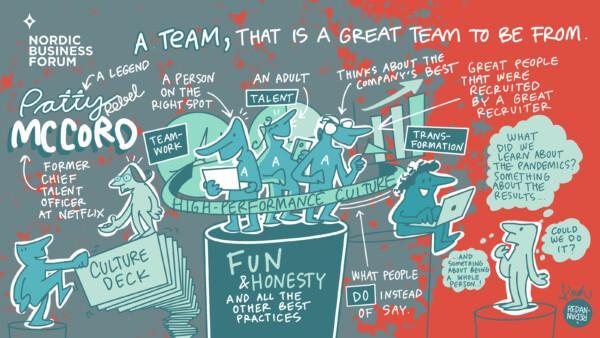
Visual summary by Linda Saukko-Rauta
Key points and Questions for Reflection
Key points
- Hire and manage adults: Replacing restrictive rulebooks with personal accountability allows responsible employees to make disciplined decisions independently.
- Lead with context over control: Elite teams execute effectively when leadership provides clear strategic metrics rather than micromanaging daily activities.
- Work backward from a 6-month movie: Visualize what exceptional team performance looks like six months out, identify the required capabilities, and recruit specifically for those outcomes.
- Write problem-focused job descriptions: Define roles by the specific operational challenges a candidate must resolve within a defined timeframe rather than arbitrary years of experience.
- Make feedback continuous: Ditch annual performance evaluations in favor of immediate, actionable coaching that reinforces high performance in the moment.
Questions for Reflection
- What internal company rules or approval processes are currently slowing your employees down without adding genuine value?
- If you directed a 6-month movie of your team operating at peak performance, what concrete operational outcomes would be visible?
- Are your current job postings focused on measurable problems to be solved, or are they relying on generic credential requirements?
- Does feedback in your organization happen naturally every day, or are issues stored away for formal review cycles?
- How can you ensure your company culture builds a reputation as an exceptional place to work and an extraordinary place to be from?