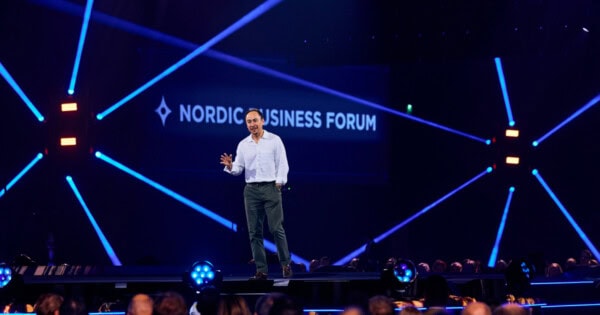
Rick Rubin isn’t your typical keynote speaker, and he wouldn’t want to be.
One of the most legendary music producers of all time, Rick has shaped the sound of Johnny Cash, Jay-Z, Adele, the Beastie Boys, and the Red Hot Chili Peppers not by telling artists what to do, but by helping them reconnect with their most authentic creative voice.
At Nordic Business Forum 2025, in a rare public conversation with Diana Kander, Rick shared the philosophies that have shaped his iconic career, ideas that apply far beyond the music studio.
For business leaders navigating uncertainty, pressure, or the constant demand for innovation, Rick offered something rare: space to think differently.
You Don’t Need to Know – You Need to Notice
Rick’s philosophy is radically simple: you don’t need to know the answer. You need to learn how to notice what’s happening.
He doesn’t approach creativity like a technician or strategist. Instead, he sees it as an energy to tune into, one that flows more freely when you stop trying to control it.
This is why Rick is famously barefoot in the studio, often meditating or simply listening with full presence. He doesn’t rely on fancy gear. He listens deeply, asks questions, and lets what’s true rise to the surface.
For business leaders, this is a challenge to step away from relentless action and shift into receptive awareness.
Start Before You’re Ready
When asked what “moving forward” means to him, Rick’s answer was disarmingly simple: “Take action. Even when you’re not sure what to do.”
He explained that forward motion isn’t about knowing the outcome, but about resisting the trap of waiting for the perfect moment. Even a misstep offers valuable information. Standing still, paralyzed by the need to be “ready”, is what blocks progress.
“If I waited until I was ready, I wouldn’t be sitting here right now.”
This perspective challenges a culture obsessed with planning, precision, and performance. According to Rick, clarity comes through doing. And when in doubt? Take a small step. Then listen.
Creativity Comes From Within
Throughout the session, Rick emphasized the idea that real creativity comes from tuning into what feels right, not what’s expected. “You don’t get creativity from someone else telling you how to do it. That’s just following directions,” he stated.
Rick’s process is grounded in authenticity. He listens to others, but ultimately, he follows what feels right in his body, not just his brain. This principle, he says, applies to building companies, solving problems, and making music.
He pointed out that in the business world people tend to regard the business as something external rather than part of themselves. Even in industries driven by short-term results, the best outcomes emerge when leaders trust their instincts and refuse to be bound by tradition.
“If people tell you you’re crazy, you might be on the right track. It’s a good sign.”
Redefining Failure, Feedback, and Fear
Rick doesn’t see failure the way most of us do. For him, failure isn’t the end. Instead, it’s feedback in disguise, another part of the experiment. In his own words:
“Failure is the information you need to find the right direction.”
This mindset also shapes how he gives feedback. Whether he’s in the studio with Jay-Z or coaching a nervous new artist, his first rule is: do no harm. He avoids criticism that could extinguish someone’s passion. Instead, he asks questions, suggests experiments, and always respects the other person’s vision, even if it conflicts with his own.
In fact, he told the audience that when there’s disagreement, he lets the artist win. It’s not just humility; it’s empathy.
“They have one career. I have many artists. I’ll always side with them against my own instincts,” he explained.
And it reflects a broader belief that creativity cannot be forced, only supported.
The Long Game Is the Only Game
In a business world addicted to quarterly results, Rick advocates for playing the long game. He encouraged leaders to zoom out and consider what their decisions mean one, five, even ten years from now.
He referenced Amazon as an example: “20 years of losing money before becoming the most successful company in history”. And challenged the audience to prioritize long-term beauty over short-term pressure.
He also shared how solitude, nature, and stillness fuel his creativity more than any boardroom. His version of productivity? Walking in forests. Sitting in saunas. Listening, not forcing. “If you can get quiet enough inside, the answers come your way,” he said.
Let the Idea Speak
One of the most practical takeaways came from how Rick handles disagreement in teams. He avoids persuasion altogether and sums up this idea in a powerful quote:
“Persuasion leads to mediocrity.”
Instead of debating ideas hypothetically, he asks people to build a model, a demo, a sketch, or a prototype. When the idea exists outside of people’s heads, it becomes something everyone can explore without ego or ownership.
This approach makes collaboration less personal and more productive. It’s not about who’s right. It’s about what works best.
AI, Human Uniqueness and Trusting Your Heart
Rick also touched on artificial intelligence, something he stumbled into through a viral meme that inspired his unexpected project: The Way of Code: The Timeless Art of Vibe Coding.
His conclusion? AI is a tool, not a threat. What gives people value isn’t their access to data, but their point of view. Their life experience. Their emotional fingerprint.
To illustrate this idea, Rick recalled having heard an AI Jay Z song that sounded like his voice and his style. But it didn’t make a difference. “We don’t listen to Jay Z to hear his voice. We listen to Jay Z to hear his point of view. The AI doesn’t have a point of view.”
In closing, Rick urged the audience to follow their inner voice for the best outcome:
“Trust your heart. There is no wrong decision when you’re trusting your heart.”
Key Points and Questions for Reflection
Key Points:
- Start moving before you’re ready. Progress is found in action, not perfection.
- Creativity comes from authenticity. Trust your internal compass, not external approval.
- Failure is data. Each misstep is simply a step closer to what works.
- Feedback should never harm. Respect the vision of others, even if it’s not your own.
- Avoid persuasion. Build models. Let the idea prove itself.
- Stillness fuels clarity. Spend more time in nature, and less time in noisy or distracting environments.
Questions for Reflection:
- What action have you been delaying because you’re “not ready”? What’s one step you can take today?
- Where are you following rules that no longer serve you or your business?
- Are you giving feedback that uplifts, or feedback that quietly undermines?
- Are you trying to persuade people, or are you building a model they can see for themselves?
- How do you make room for creativity within your team or organization?