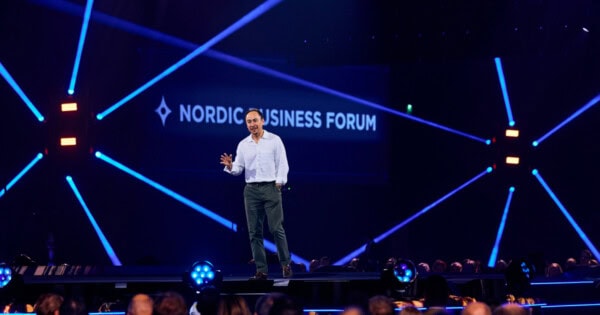
In a world where professionals are less tied to organizations yet more committed to their craft, Gianpiero Petriglieri, Professor of Organizational Behaviour at INSEAD, challenged leaders to reimagine their role.
Great workplaces, he argued, are not just places where tasks get done. They are identity workspaces; places where people discover, develop, and express who they are.
“In identity workspaces, we can discover and develop our working selves. And the more we belong, the freer we feel.”
From Nomadic Professionals to Identity Workspaces
Today’s professionals, Gianpiero explained, live in an era of nomadic professionalism. People move between organizations with less loyalty, but carry a strong sense of purpose and attachment to their work.
This creates both opportunity and anxiety. Leaders often respond with culture programs meant to keep people in place without letting them move on. But that approach misses the point. The best workplaces go further—they stretch people, not just welcome them.
“In your most memorable workplace, people don’t just welcome you. They imagine you.”
The Workplace as Home, Not a Machine
Too often, organizations still treat themselves like factories or machines. They ask only instrumental questions: Is this efficient? Is this economical? Is this influential?
Gianpiero suggested leaders need to rebalance these with humanistic questions: Is it safe? Is it hospitable? Who lives here and how?
“A home has a strong culture not when it demands loyalty. A home has a strong culture when it generates learning.”
This insight reframes culture’s role. Culture is not about enforcing conformity or ensuring people stay put. It is about helping people grow, so they can give more and, eventually, leave better than they arrived.
Competence, Courage, Connection
Drawing from his study of 70 organizations, Gianpiero outlined three kinds of learning that make workplaces into true homes for talent:
- Convergent learning: building competence through standards, role models, and feedback.
- Divergent learning: cultivating courage through challenges, space, and questions that push us beyond comfort zones.
- Relational learning: creating connection by engaging with people different from ourselves.
When a workplace fosters all three, people don’t just improve their skills. They also build resilience, expand their horizons, and deepen their relationships. These qualities, in turn, strengthen the organization as people bring back new ideas, perspectives, and energy.
Love, Learn, and Legacy
Gianpiero also placed culture in a deeper human context. Biologically, humans are designed to attach (love) and to explore (learn). Consciousness adds a third dimension: the search for transcendence. We want to leave a legacy.
That’s why workplaces must do more than pay salaries and demand productivity. They must embrace this paradox of human existence: our need for pleasure and purpose, survival and meaning.
“The job of a strong culture is to keep everyone alive.”
Everyone should feel alive not only in a physical sense, but emotionally and intellectually. We should aim for feeling alive with curiosity, connection, and possibility.
Leaders as Hosts
So what does this mean for leaders? Gianpiero offered a clear answer: leadership is an act of hosting.
Leaders make things, invite people, and host them. They create the conditions for both work and life to thrive. To do this, leaders must keep two conversations alive:
- What we make: How does our work create value, and how might it harm?
- How we live: How does our culture shape us, and what costs does it bring?
He encouraged leaders to ask their teams directly: “The work we do here makes us better because..” together with “It makes us worse because…”. Similarly, they should ask “The way we live here makes us better because…” and “ It makes us worse because…”
These questions keep leaders grounded in both the instrumental and humanistic dimensions of their work.
Success Redefined
For Gianpiero, the largest change in mindset to build more home-like organizations is to remember: “People live here.”
And give up thinking about work-life balance. “The opposite of life is not work. The opposite of life is death,” he pointed out. When we say work-life balance, we are implying that work is deadening and deadly.
The ultimate measure of a successful workplace is not whether people stay forever. It’s whether they join freely, grow stronger, and leave grateful.
Key Points and Questions For Reflection
Key Points
- Nomadic professionalism: People are less tied to organizations but deeply committed to their craft.
- Identity workspaces: The best workplaces stretch people by imagining who they could become.
- Culture as learning: Strong cultures generate competence, courage, and connection.
- Leaders as hosts: Leadership is about making, inviting, and hosting, while balancing what we make and how we live.
- Culture’s job: Not to enforce loyalty, but to keep people alive and thriving at work.
- True success: When people join freely, grow closer, and leave grateful, ready to build homes of their own.
Questions for Reflection
- Does your organization feel more like a factory of efficiency or a home for talent?
- How does your culture help people build competence, courage, and connection?
- What human questions do you ask alongside business metrics?
- How do you “host” your people? Do they feel stretched, supported, and alive at work?
- If your employees left tomorrow, would they leave grateful, and more capable of building homes of their own?