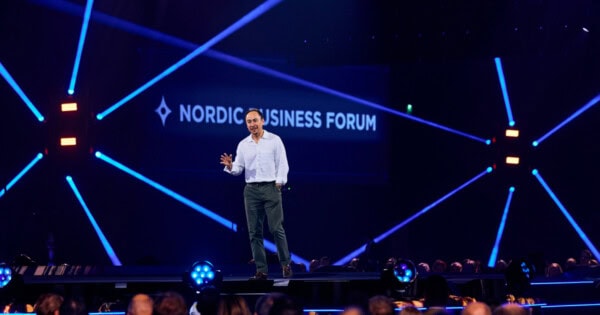
Risto Siilasmaa, former Chairman of Nokia, founder of cybersecurity company F-Secure, and investor in over 50 companies (including seven unicorns), brought a clear and urgent message to the Nordic Business Forum stage: the future does not reward those who predict it best. It rewards those who act.
This principle, which Risto calls strategic agency, lies at the heart of resilient leadership. By building the muscles of observation, thinking, and action, leaders can navigate uncertainty, seize opportunities, and avoid the paralysis that comes from fear or lazy assumptions.
Here’s a written summary of Risto’s keynote, and you can also watch the entire talk on our Youtube channel.
The Power of Strategic Agency
Risto opened with a simple but powerful distinction: the future does not reward those who merely see it most clearly, but those who act on what they see. And called strategic agency the ability to anticipate the future and act on it.
Strategic agency is not luck, Risto stressed. It’s a discipline. Leaders must consistently practice three skills:
- Observation: Seeing the world as it is, not as we hope it to be.
- Thinking: Using mental tools and scenario planning to explore consequences.
- Action: Moving boldly, even when outcomes are uncertain.
Each element is necessary. Observation without thinking leads to panic. Thinking without action leads to paralysis. Action without observation leads to recklessness. Together, they form the muscle memory of a future-ready leader.
“Observe, think, and act: these are the three muscles you need to build to achieve strategic agency.”
To explain how leaders can develop strategic agency, Risto discussed examples that revolved around demographics, technology as the biggest value creator in the world, and the use of AI.
Demographics as Destiny
Some forces are inevitable, and demographics is one of them. Fertility rates are dropping worldwide—including in China and many other countries. This shift will shape labor markets, economies, and industries for decades to come.
“Even if fertility rates magically increased overnight, the number of people of fertile age wouldn’t change for decades,” Risto noted. The implication is clear: leaders cannot ignore demographic shifts when planning strategy.
Lazy vs. Deliberate Thinking
Risto contrasted “lazy thinking” with deliberate, structured analysis. Lazy thinking is relying on surface-level data or common assumptions. Deliberate thinking means asking second-order questions and considering invisible risks.
He illustrated this with a story from World War II and the Battle of Britain.
Engineers reinforced aircraft where returning planes showed bullet holes, assuming those spots were the weak points. But statistician Abraham Wald realized the opposite: the planes that didn’t return had probably been hit in other areas. “So the weaknesses were in the places with no bullet holes at all,” Risto explained. This story underscores a key insight: the damage you don’t see is often the most dangerous.
Risto encouraged the audience to deliberately exercise the muscle of thinking. For leaders, this means developing a toolkit of mental models and scenario-planning exercises that push them beyond the obvious.
“Try asking ChatGPT for existing processes for analytical thinking. You’ll find lots of mental toolkits to help you think better.”
Technology as the Biggest Value Creator
Risto pointed to stock market data from the last decade: technology companies grew by 510%, while all other sectors combined grew by just 60%.
Extrapolating the trend, he suggested that by 2035, technology could add between $40 trillion and $290 trillion in value—figures comparable to the size of global real estate. These numbers, while uncertain, show why tech-driven value explains much of today’s geopolitical tensions, trade wars, and industrial policies.
The conclusion is that technology is not just another sector. It’s the largest and deepest value creator in the world. From AI to cloud computing, from biotechnology to cybersecurity, technology reshapes every industry.
“Technology is the biggest value creator in the world. Its impact is deeper and more fundamental than we realize.”
Acting on AI
Among the most urgent technologies, Risto highlighted artificial intelligence. Costs are dropping, expertise is spreading, and investment is accelerating. Leaders cannot afford to dabble with incremental steps.
His advice was clear: don’t aim for 50% improvements. “Aim for 500% or even 5,000%,” he said. Only then are you forced to rethink the entire process, and that’s when AI shows its true power.
Risto described the coming of artificial general intelligence (AGI) as not only plausible but likely before 2030. For businesses, AGI will not just be a tool but a colleague: tireless, endlessly knowledgeable, and capable across domains. His call to leaders is simple: start acting now.
Practice Creates “Luck”
Strategic agency is not something leaders turn on in a crisis. It’s built like any other skill: through practice and repetition.
Risto compared it to golf. The more you practice, the more natural the swing becomes, and the luckier you seem. But luck is actually when preparation meets opportunity.
In closing, he reflected that the further we look into the future, the more possibilities we can imagine. Not all will be plausible, and even fewer will be probable. Yet through our own actions, we have the power to bring the plausible and the probable together.
“Thinking doesn’t matter if you don’t act on it.”

Key Points and Questions for Reflection
Key Points
- Strategic agency: Build the muscles of observation, thinking, and action.
- Demographics: Population shifts are inevitable and must shape strategy.
- Lazy thinking: Superficial analysis blinds leaders to hidden risks.
- Technology dominance: Tech is the world’s largest and deepest value creator.
- AI urgency: Don’t settle for small gains. Rethink whole processes.
Questions for Reflection
- How much time do you spend strengthening your muscles of observation, thinking, and action?
- What demographic shifts could impact your industry in the next 10–20 years?
- Where might lazy thinking be blinding your organization to invisible risks?
- Are you treating technology as just another sector, or as the biggest driver of value in your business?
- How could you redesign processes by aiming for 5,000% improvements instead of 50%?