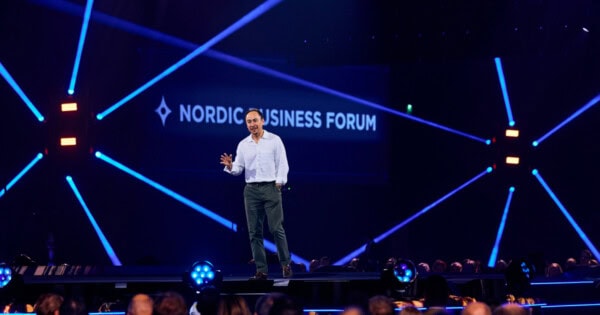
When Howard Yu, LEGO® Professor of Management and Innovation at IMD Business School, took the stage at Nordic Business Forum 2025, he brought a simple but powerful message: the future belongs to the ready.
Howard, who leads IMD’s Center for Future Readiness, has spent years studying why some companies adapt, rebound, and grow while others stagnate or fail. His conclusion? Future readiness is not about luck or one-time bets. It is about habits, culture, and the discipline of staying just one inch ahead.
Perform and Transform
Howard’s first principle is what he calls perform and transform. Most companies act like pendulums. In good times, they invest in moonshots and innovation. When a downturn hits, they retreat to cost-cutting and short-term earnings.
This swing is deadly. Future-ready companies, by contrast, deliver today and build tomorrow simultaneously.
He illustrated this with the story of Basel’s pharmaceutical giants Roche and Novartis. Starting as textile dye makers, they reinvented themselves over generations: first into painkillers, then antibiotics, and today into genomics and immunotherapy. Each step required scaling new capabilities while sustaining their existing businesses. As Howard put it:
“In order to stay on top of competition and relevant, we’ve got to scale up new capabilities.”
Own It and Show It
The second principle is about agility through ownership and transparency. Transformation isn’t one big gamble but a series of experiments. Some will fail. Some will succeed. What matters is the ability to learn, adapt, and scale quickly.
Howard stressed that leaders must be willing to cut projects that are “pretty good” so they can double down on the truly great. “Kill the pretty good, scale the truly great,” he emphatically pointed out.
He also challenged leaders to ask themselves a tough question: “To what extent can you say to your colleagues, ‘This isn’t working. Let’s kill it and move on’?” If doing that feels like career suicide, then culture needs to change.
Tesla’s rise shows what this principle looks like in practice. Their real advantage wasn’t only in design or battery technology, but in software updates, direct customer data, and constant learning. Howard summed it up with a memorable line: “If Apple’s iPhone had four wheels, that’s Tesla.”
Make Yourself Ridiculously Easy to Work With
Howard’s third principle is about partnerships. Companies that thrive in disruption don’t hoard their technology. They make it easy for others to adopt, adapt, and build on it.
Nvidia is a prime example. Long before AI became mainstream, the company invested billions to create software that allowed anyone, from scientists to startups, to use their chips. They even gave the tools away for free. Wall Street called it madness. Today, Nvidia is one of the most valuable companies in the world.
“Don’t be a hoarder. Make yourself ridiculously easy to work with.”
The Power of Individuals: Find Your “Tony”
While Howard’s research focuses on companies, he reminded the audience that future readiness is also personal. He told the story of Tony, a young factory engineer at Mars.
Tony volunteered, without extra pay or a new title, to work on digital initiatives. His first project, an augmented reality training tool, was ignored at first. But when the pandemic hit, it became indispensable. Tony went from the factory floor to presenting at the board level, and today he leads advanced manufacturing globally for Mars.
“Your biggest innovation may not come from consultants’ reports but from the email of a 23-year-old with an idea.”
The Plus-One Mindset
Howard urged individuals to build what he calls “plus-one skills.” In an age of AI, being narrowly specialized is risky. The best lawyer who only drafts contracts can be replaced by software. The best programmer who only codes can be replaced by AI-generated tools.
The real value comes from combining expertise with something new: law with consumer psychology, coding with design thinking, or factory knowledge with augmented reality.
“Beyond my current mastery, what is the new skill I’m going to scale?”
This plus-one mindset makes individuals unfireable and companies adaptable.
One Inch Ahead
Howard closed with encouragement. Becoming future-ready is not about perfection or giant leaps. It is about consistent progress.
“You don’t need to be perfect,” Howard said. You just need to be one inch ahead of yesterday’s problem or maybe one inch ahead of your competition.
For leaders, that inch might mean empowering experimentation or cutting outdated practices. For individuals, it might mean learning one new skill or starting a side project. Over time, those inches add up to future readiness.
Key Points and Questions For Reflection
Key Points
- Perform and transform: Deliver today while building tomorrow simultaneously.
- Own it and show it: Take full ownership, learn fast, and kill the merely good to scale the truly great.
- Easy to work with: Make your company an enabler, not a hoarder, to unlock unexpected opportunities.
- Find your “Tony”: Empower young, curious employees with ideas and courage.
- The plus-one mindset: Combine your expertise with new skills to stay relevant in the age of AI.
- One inch ahead: Progress doesn’t require perfection, just consistent forward movement.
Questions for Reflection
- How well does your organization balance performing today with transforming for tomorrow?
- Can your team openly say, “This isn’t working. Let’s kill it and move on”?
- What barriers prevent your company from being “ridiculously easy” to work with?
- Who are the “Tonys” in your organization, and how can you give them space to experiment?
- What is your personal “plus-one skill” that will keep you future-ready?