Over the last few years, business leaders watched artificial intelligence evolve from a curiosity into an everyday workplace utility. Between 2022 and 2025, most companies experimented with generative tools in three basic ways: polishing emails, rewriting social media biographies, and generating novelty images.
Then, reasoning models advanced, opening the door to agentic workflows where software began executing complex tasks autonomously.
Today, we are entering the artificial general intelligence (AGI) era. Autonomous agents can now operate computer software directly, navigating design platforms, databases, and enterprise systems far faster than people can click and type. As routine execution becomes automated, executives face a crucial strategic question: when machines can optimize and execute almost everything, where does the true human advantage lie?
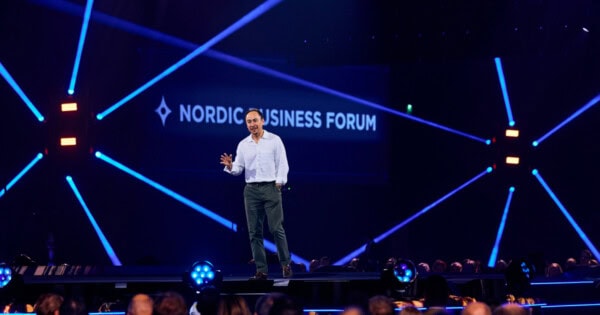
At Nordic Business Forum 2026 in Helsinki, innovation strategist and bestselling author Shawn Kanungo addressed thousands of business leaders on how to capture that edge.
His central message was bold and challenging: AI is the ultimate engine of conventional wisdom. To build resilient, market-leading organizations, leaders must move beyond incremental efficiency and fundamentally reimagine their businesses with AI, exercise courageous judgment, and introduce intentional friction.
What Is the True Power in the Age of AGI?
For generations, business culture operated under the belief that knowledge is power. When search engines and early generative tools made information universally accessible, that belief shifted. In the newly forming environment, execution became power. Now that autonomous agents can orchestrate complex workflows across multiple software applications, execution itself is becoming commoditized.
“To me, what is power today is judgment. The easier that it becomes to do anything, the more it matters what you choose to do.”
When anyone can generate code, draft marketing copy, or analyze spreadsheets instantly, technical execution alone no longer creates a sustainable moat. The competitive differentiator shifts upstream to discernment, taste, and the courage to ask questions that challenge industry assumptions.
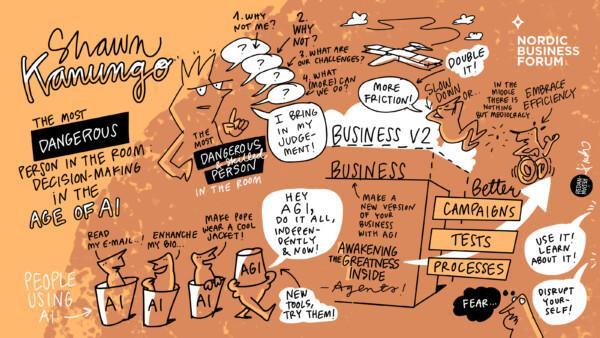
Shawn illustrated this dynamic with a historical thought experiment. If Orville and Wilbur Wright had consulted modern generative algorithms in the late nineteenth century, the software would have synthesized the consensus of the scientific community at that time, concluding that mechanical human flight was impossible.
AI synthesizes what already exists, which makes it an engine for conventional wisdom. The role of the human leader is to ask the questions machines cannot conceive, beginning with “Why not?” and ultimately asking, “Why not me?”
Why You Must Rebuild Your Company from Zero
When most corporations adopt new technologies, they make a predictable mistake: they bolt AI onto their existing, clunky workflows. They add an assistant to an outdated approval chain or automate a status report that should not exist in the first place.
Shawn urged leaders to stop patching old systems and instead create a “V2” of their organization. A V2 means using zero-based thinking to reimagine your company from scratch with AGI at its core. If you were founding your business today with autonomous agents available to handle research, design, coding, and administrative logistics, how would you structure the enterprise?
On stage, Shawn demonstrated what this looks like in practice. Using autonomous computer-use agents, he built a functioning 3D digital twin of Helsinki layered with public service request data. He also demonstrated how autonomous agents could identify open positions at a major Finnish retail company, locate twenty qualified candidates for each role, build a candidate ranking dashboard, and draft personalized outreach.
Finally, he showed how an entire creative marketing footprint for an iconic Finnish design house could be reimagined, tested, and personalized in minutes.
Going from zero to one hundred to scale a company is exciting, but the hardest leadership discipline is going from one hundred back to zero to disrupt yourself. By starting from a clean sheet, organizations stop settling for 10% efficiency gains and unlock tenfold leaps in capability and speed.
Avoid the Black Hole of Mediocrity: The Power of Friction
In an economy where digital processes become virtually instantaneous, businesses face a critical strategic fork in the road. Shawn warned that organizations must choose between two distinct operating models to avoid getting trapped in the middle:
- Fast and Frictionless: Companies that compete on sheer speed, automation, and effortless self-service. Customers press a button, and the solution arrives at their door. Brands like Amazon operate successfully here.
- Intentional Friction and Deep Craftsmanship: Organizations that deliberately slow the customer experience down to create memorable, face-to-face, deeply human connections. Examples include luxury houses like Hermès, high-touch hospitality at the Four Seasons, or personal consultations at Apple’s Genius Bar.
The danger zone is the middle ground, which Shawn called the black hole of mediocrity. Companies in the middle are neither fast enough to beat automated platforms, nor thoughtful enough to create authentic human value.
Leaders must audit every internal and external touchpoint across their business. Back-office administrative tasks, transaction processing, and data workflows should be made entirely autonomous and frictionless.
Conversely, customer relationships, creative direction, and moments of care should be infused with deliberate human friction to build long-term loyalty.
How to Disrupt Yourself Before Competitors Do
Embracing technological transformation often stirs anxiety across teams. Employees worry that autonomous systems will replace their jobs or make their hard-earned skills obsolete.
Shawn challenged leaders to reframe their perspective on change: “My advice is to work scared until you become scary. Work scared until you become dangerous.”
The professionals who thrive in this environment are not those who ignore reality or protect outdated routines. They are the individuals bold enough to try to automate their own daily tasks. The employee who actively automates their routine duties frees their time and cognitive energy to tackle larger strategic challenges, immediately making themselves the most valuable contributor in the room.
For over a century, organizations designed roles around rigid technology, forcing people to act as cogs in assembly lines or database operators. AGI allows leaders to invert that structure. By offloading administrative chores to autonomous agents, companies can finally organize teams around the unique human gifts of their people: empathy, strategic taste, storytelling, and relationship building.
The Courage to Move Forward
In closing, Shawn argued that the future of business belongs to leaders who combine technological fluency with emotional bravery.
“The only thing I know about the future is that the most dangerous person in the room is the person who is most afraid, yet bold enough to move forward.”
Rather than delegating innovation to technical teams or waiting for industry playbooks to be written, business leaders must immerse themselves directly in the tools, experiment aggressively, and lead their organizations with clarity, conviction, and heart.
Key points and Questions for Reflection
Key points
- Judgment is the new competitive power: As autonomous agents commoditize technical execution, the greatest business value lies in taste, discernment, and asking original questions.
- AI represents conventional wisdom: Algorithms synthesize past patterns; true breakthroughs come from human innovators willing to defy established consensus.
- Build a V2 from scratch: Instead of bolting AI onto broken legacy processes, use zero-based thinking to reimagine your company from zero to unlock tenfold gains.
- Escape the black hole of mediocrity: Winning organizations will either be fully frictionless and automated, or high-touch and experiential; occupying the middle ground leads to irrelevance.
- Bring back intentional friction: While back-office operations should be streamlined, customer interactions and creative processes gain value through deliberate human connection.
- Automate your own routines: The most valuable employees and leaders are those who automate their daily tasks to focus on higher-level value creation.
Questions for Reflection
- If you were to launch a “V2” of your business today with autonomous agents handling operations, what would your organizational chart look like?
- Which legacy processes in your company are currently surviving on conventional wisdom and need to be challenged?
- Is your customer experience drifting into the “black hole of mediocrity,” or are you clear on where you deliver frictionless speed versus high-touch human connection?
- Where can you deliberately introduce human friction into your client relationships to create meaningful, memorable moments?
- What routine tasks on your personal calendar could you automate this week to free up cognitive space for higher-leverage strategic thinking?