In a world still adjusting to the aftershocks of the pandemic, accelerating digital transformation, and ongoing economic instability, leadership has never been more complex—or more human.
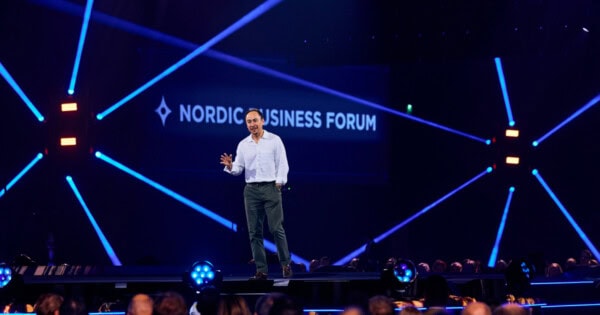
Leadership visionary Simon Sinek returned to Nordic Business Forum and challenged business leaders to stop chasing short-term wins and start building cultures that are designed to last.
During a moderated discussion with Maddy Savage, Simon conveyed a clear message: in business, there’s no such thing as winning. There is only playing better for longer.
The Evolution of Purpose-Driven Business
Simon’s career took off when he introduced the concept of Why. Today, purpose is a buzzword, but back then, it was dismissed as “hippie-dippie stuff.” Now, most companies have at least some sort of a purpose statement. But how do we know if it’s genuine? “It’s very easy. Just look at the decisions they make,” he explained.
As an example, Simon told us the story of CVS, a major US pharmacy chain, that removed cigarettes from its stores to stay aligned with its purpose: “We care about the health of our customers.” The decision cost billions in revenue, at first. But it paid off in brand trust, employee pride, and customer loyalty.
Why the Infinite Game Changes Everything
One of Simon’s most impactful frameworks is The Infinite Game. It’s a mindset shift that separates sustainable leaders from those chasing quarterly wins.
Finite games, like football, have known players, fixed rules, and a clear winner. Most importantly, they have a defined beginning, middle, and end.
Infinite games, such as business, relationships, or health, do not. Their players can be both known and unknown, meaning you don’t necessarily know everyone involved. New players can join at any time, and the rules are flexible — everyone can play in their own way. The goal of an infinite game is not to win, but to keep playing, to sustain and evolve the game itself.
“The standard way of doing business accepts as norm short-termism, shareholder supremacy and using redundancies and mass layoffs on a regular basis to manage the books — all very finite minded things.”
When leaders play a finite game in an infinite context, Simon warns, trust, cooperation, and innovation decline. But when businesses embrace the infinite mindset, something powerful happens: they build resilience. They last.
Simon pointed to Airbnb as an example of a company playing the infinite game. And he urged leaders in the audience to consider building their companies so that they can last beyond themselves.
Rethinking Leadership: Curiosity Over Judgement
As he addressed the question of how leaders could build the infinite game mentality into their business, Simon offered a refreshingly simple tip: replace judgement with curiosity.
For example, poor performance is usually met with pressure and difficult conversations. But curiosity creates psychological safety, which leads to better results over time.
Instead of saying: “Your performance has been down for the past three months. We’ve had this conversation before. If you don’t pick up your numbers, I don’t know what’s going to happen.” Simon encouraged the audience to take a different approach: “Your numbers had been down for the past three months. We’ve had this conversation before. Are you okay? I’m worried about you. What’s going on?”
This kind of empathetic leadership doesn’t make leaders soft. It makes them effective. People work harder for leaders who care about them, and the business becomes stronger as a result.
Loyalty Goes Both Ways: Understanding Gen Z
Simon also touched on the intergenerational tension many companies feel. Younger employees are often seen as disloyal or entitled, but he perceives things differently: Gen Z grew up watching their parents or their parents’ friends get laid off at the end of a profitable year. “We gave them no loyalty. They’re just playing by the rules we created.”
Simon challenged leaders to stop expecting loyalty if they’re not willing to offer it. That means showing up for your people, especially when times are tough. If you do, they’ll stay, not out of fear, but because they feel safe, seen, and valued.
“If you understand the root of the behavior, then you know what the real motivation is, what’s driving the behavior, and that’s where you play.”
Once they understand that, leaders can say things like: “If we struggle, you’ll still have your job.” At first, the younger generation will not believe them, but if leaders are true to their word and act accordingly, they will start to recognize that their job is different from their friend’s jobs. And they’ll stay because they will feel that psychological safety: a sense of belonging, that they matter, that their work matters.
Rediscovering the Power of Friendship
In a surprising and deeply human turn, Simon spoke about his new research focus: friendship. He argued that while business has endless frameworks for leadership and even love, we often overlook the value of being a good friend. “We overvalue romantic relationships. We undervalue friendship.”
Simon offered a new definition of friendship that applies to teams, partnerships, and even company culture. As he says, “A friend is a person with whom you agree to grow together.”
He also challenged the audience to rethink what trust really looks like. We often believe that offering help builds trust, but Simon flipped the script: “We build trust not by offering help, but by asking for it.”
In other words, giving others the chance to show up for you, to be needed, to serve, is one of the deepest expressions of connection.
“Part of being a friend with me and part of me being a friend with you is I will give you the honor to be there for me, but you have to give me the honor of being there for you.”

Key Points and Questions for Reflection
Key Points:
- Purpose is a decision-making tool, not just a marketing slogan.
- Business is an infinite game: the goal is to keep playing, not to “win.”
- Great leaders replace judgment with curiosity and create space for trust and empathy.
- Younger generations aren’t disloyal. They’re responding to the systems they grew up in.
- Friendship matters. In business and in life, deep human connection fuels growth.
Questions for Reflection:
- Are your company’s decisions consistent with its purpose?
- What would change if your team played the infinite game instead of the finite one?
- When was the last time you responded to poor performance with curiosity?
- How can you create more trust by asking for help, not just offering it?
- Are you building a culture of growth and friendship at work?