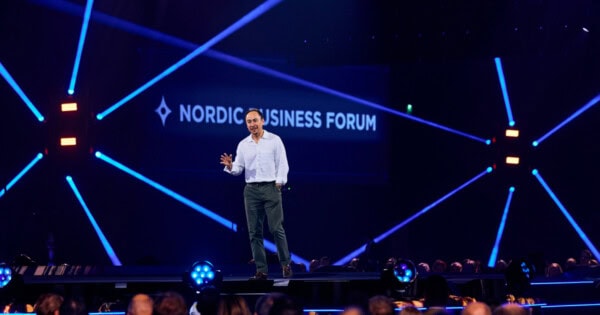
Peter Hinssen, Belgian entrepreneur, author, and board advisor, brought both energy and urgency to the Nordic Business Forum stage with one central message: disruption is no longer temporary. It is the climate we live and lead in.
With humor, storytelling, and sharp observations, Peter explained why the pace of technological change is accelerating, why traditional strategies no longer work, and how leaders can reinvent themselves and their organizations to thrive in what he calls the never normal.
Technology’s Relentless S-Curve
Peter has spent decades analyzing patterns of technological change. He described how every breakthrough follows a familiar S-curve: slow adoption at first, then exponential growth, and finally, normalization.
Mobile phones, for example, were once rare and unfamiliar. Today, they are so embedded in our lives that it is hard to imagine a world without them.
The challenge now, Peter argued, is that these waves are becoming faster, higher, and more powerful.
Artificial intelligence is the latest and possibly most transformative example. For Peter, the debate is no longer about if AI will change our world but about how quickly and how profoundly it will happen.
“There are decades where nothing happens. And then there are weeks where decades happen.”
This reality demands a new mindset from leaders. Waiting for the dust to settle is not an option.
Innovate When You Can, Not When You Must
In the past, companies often delayed innovation until they were already in decline. That playbook, Peter warned, no longer works. We are now living in what he calls the “never normal”, a time when you have to innovate when you can, not when you need to. Because if you wait until you don’t have a choice, you will be too late.
This shift requires courage. Leaders must be willing to invest in reinvention while things are still going well, rather than clinging to the safety of the present.
The lesson is clear: if you keep applying yesterday’s logic to today’s turbulence, you will not survive tomorrow. Or as Peter put it:
“The greatest danger in times of turbulence is not the turbulence. It’s to act with yesterday’s logic.”
The Day After Tomorrow
One of Peter’s most striking models is what he calls the Day After Tomorrow framework. He divided leadership focus into three categories:
- Today: the endless flood of emails, messages, and urgent operational tasks.
- Tomorrow: the near future, usually extrapolated from current comfort zones.
- The Day After Tomorrow: the innovations, experiments, and radical ideas that could redefine the business.
In reality, most organizations spend almost all their energy on today, a little on tomorrow, and nothing on the day after tomorrow.
Worse still, they often waste time on what Peter called the “shit of yesterday”, which consists of outdated processes and tasks that drain resources.
“If you focus on cleaning up the shit of yesterday, you will never get to the day after tomorrow.”
For leaders, the challenge is to carve out time, energy, and resources for the day after tomorrow. That is where real transformation lies.
Anticipate, Adapt, Resilience
Peter’s formula for leading in uncertain times is simple but powerful: anticipate, adapt, and build resilience.
- Anticipation means spotting signals before competitors, understanding weak trends, and connecting the dots earlier.
- Adaptability is about flexibility and the willingness to change direction quickly.
- Resilience ensures that when experiments fail—and some will—you bounce back stronger.
He reinforced this mindset with a quote from the French philosopher Voltaire: “Uncertainty is an uncomfortable position, but certainty is an absurd one.” In other words, leaders should stop chasing the illusion of certainty and instead build the capacity to navigate uncertainty with confidence.
People, Mindsets, and Positive Troublemakers
Technology is only part of the story. For Peter, the real challenge lies in people and mindset. Organizations often have two types of contributors:
- Soldiers, who excel at executing established processes.
- Artists, who imagine new futures and challenge assumptions.
The magic happens when both are balanced. A company of only artists would be chaos, but a company of only soldiers would stagnate.
Peter emphasized the role of “positive troublemakers” and “frustrated enthusiasts”, the small percentage of employees willing to push boundaries and challenge the 99% who are comfortable doing what they’ve always done. These individuals often spend more energy fighting resistance than innovating. Leaders must identify, support, and empower them, because they are essential for reinvention.
From Surviving to Thriving
Too many businesses, Peter warned, confuse survival with success. Building moats and defending castles may keep competitors at bay for a while, but survival is not the same as growth.
True leadership in the never normal requires bold vision, flexible execution, and the courage to go beyond incremental improvement. This is not about predicting the future with certainty.
It is about being comfortable moving forward even when all the pieces are not yet visible. Rather than puzzle solvers who must find the missing pieces, Peter pointed out that leaders must become mystery solvers: people who can move forward without knowing all the pieces.
Final Call to Action
Despite painting a picture of extreme flux, Peter’s message was ultimately optimistic. “The good thing is you have a chance to do something about it,” he said as he reminded the audience how quickly humanity has advanced, for example from the Wright brothers in 1903 to the moon landing in 1969.
The never normal is not a passing storm. It is the climate in which leaders must build, innovate, and inspire. Those who dare to anticipate, adapt, and reinvent will not just survive, they will thrive.

Key Points and Questions for Reflection
Key Points
- The Never Normal: Uncertainty is permanent, not temporary.
- Day After Tomorrow: Invest in future-shaping ideas, not just today’s tasks. And get rid of outdated processes and tasks that drain resources.
- Formula for Uncertainty: Peter’s tip for leaders in uncertain times is to anticipate, adapt, and build resilience.
- Empower Troublemakers: Support the people pushing for change.
- Survive vs. Thrive: Don’t settle for survival. Reinvent to thrive.
Questions for Reflection
- How much time does your organization spend on today, tomorrow, and the day after tomorrow?
- What outdated practices, or the “yesterwork”, are draining your team’s energy?
- Who are the positive troublemakers in your company, and how can you empower them?
- How can you shift from puzzle solving to mystery solving in your leadership?
- Are you focused on survival, or are you building to thrive in the never normal?