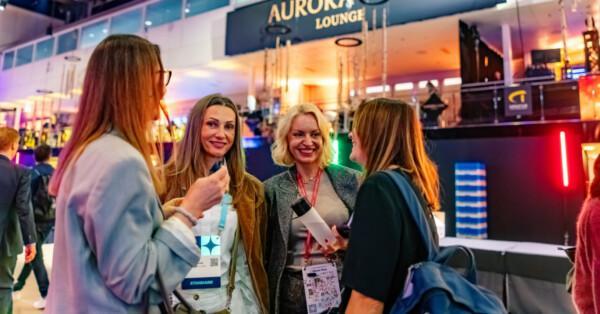
Decision making and performance. These form the essence of the human edge we are all striving to build, as we approach the edge of what it means to be human. Here are 6 impactful quotes that gave shape to these themes on day 1 at Nordic Business Forum 2026 in Helsinki.
Michael Beckley: “There is a Massive Market for Building Resilience and Redundancy.”
The repercussions of the 2008 financial crises, an event Michael Beckley described as the most significant of this century, are why the current environment feels like the third act of a mafia movie. As Michael said, “When the money’s coming in, everyone’s happy. When it starts to slow down, bodies start piling up in meat lockers.”
Post 2008 economic pressure has forced governments to adjust their projections, extract more resources, and grab new territories while they can. From tearing down walls to building them anew, an exemplar of this shift is the US tariff initiative, which, Michael believes, “is Trump’s attempt to put the American economy behind a paywall.”
Paradoxically, this has kickstarted a new wave of reindustrialisation and resilience among traditional allies. And the more valuable an ally appears, the more likely the US is to do business with them. The problem for nations going forward is not potential: it’s unity and leadership.
Kjell Nordström: “You Get Shit Done Fast if there is Trust in the System.”
The 5 Nordic supermodel states are widely reported to be the happiest, best, most equal places to live on earth. Does this matter in the age of AI? According to global business thinker and author Kjell Nordström, way more than you may think.
As Kjell explained, “There are 2 things that are different about us in the Nordics: we are probably the most extreme global cases of high trust societies, and we are very technology positive.” High trust means less friction between systems, governments, colleagues, bosses, institutions. It means flexibility, the ability to navigate through shifting situations.
And it means that the Nordics, the social embodiment of trust, organizational effectiveness, and adaptation, are uniquely positioned to see the AI genie for what is: not a tool, but rather, as Kjell described, “a device with agency that allows us to stream knowledge.” A great recipe for getting shit done.
Shawn Kanungo: “Build a Second Version of Your Company from Zero with AGI.”
According to innovation strategist Shawn Kanungo, this is the most important year of our careers. NVIDIA CEO Jensen Huang has stated that AGI (artificial general intelligence) is already here, and Shawn wanted the audience to know that “the gap between those that understand this, and those that don’t, will continue to widen exponentially.”
From conversational to agentic, AI has already proved it can not only think like us—it can get things done without our oversight. But “instead of bolting AI on top of existing processes, it’s now possible to build your organization’s digital twin from scratch and program autonomous agents to AB test every single function,” Shawn explained.
We’re now crossing a threshold where autonomous agents can do jobs that humans could never do. “This is why we need to be thinking bigger and bolder,” Shawn concluded.
Rahaf Harfoush: “Do We Really Want to Nudge People Towards Cognitive Shortcuts in an Age of Increasing Complexity?”
As digital anthropologist Rahaf Harfoush asked, “what happens when an entire culture is trained to receive the first answer it is given?” In short, we shift from a searching culture to a generating one, and we lose mastery of thinking.
Tools like Copilot are already having a big impact on the micro moments that make up the work day. We can ask AI to do just about anything (and often do), but without deep expertise and strong cognitive skills, we are often less capable of discerning if the report summary it offers up is any good.
Additionally, “We don’t just receive the default settings of the tools we bring into our lives—we inherit their ideology and belief systems,” said Rahaf. For all of history, we used our hands to learn how to think. The tools we pick up today have the potential to reverse that relationship for the first time.
Angela Duckworth: “Effort Pays Off in Some Situations More Than Others.”
When Angela Duckworth, one of the most viewed TED Talk keynote speakers of all time, tells you a critical component of leadership is “creating situations that bring out the best in other people,” it’s worth taking note.
Aside from being anatomically perfect for the sport of swimming, Michael Phelps swam with full effort, 365 days a year, for 20 years. Michael’s coach, Bob Bowman will tell you that the “kid” was talented, but the real magic was his grit.
Phelps was capable of putting forth consistent effort in the pursuit of his goals. But Michael swam at a facility with both indoor and outdoor Olympic pools for year round training, filled with driven coaches, on a team of ambitious swimmers.
“If you ask Michael how important his situation was in relation to what he achieved, he acknowledges his outcomes would be 100% different. His situation mattered,” This is why, as a leader, it’s important to create the situations that make the efforts of exceptional people pay off.
Steven Bartlett: “There’s magic in long-termism.”
In a world where public companies carve up time into quarterly chunks, and individuals set 1-year transformation goals every January, Steven Bartlett revealed that remarkable things happen when you extend your time horizons and embrace long-termism.
“If I gave you an unlimited number of bricks—and only 1 minute to build the tallest tower—you would stack them as high as you could and hope a slight gust of wind doesn’t blow your creation over. Yet if I extend your time horizon to one year, you would focus on building really great foundations,” said Steven. “The only thing that changes with the time horizon is your behaviour today.”
This precarious edifice is what Steven often finds when he peeks under the hood of startups he’s looking to invest in. Strong foundations take time to build, but like Tesla and SpaceX, trillion dollar valuations are built on multi-decade time horizons.