Artificial intelligence can now produce intellectual work at unprecedented speed and scale, from reports and code to presentations and strategic plans. But as these tools become more capable, a critical question emerges: How do we ensure they elevate our organizations rather than erode our thinking?
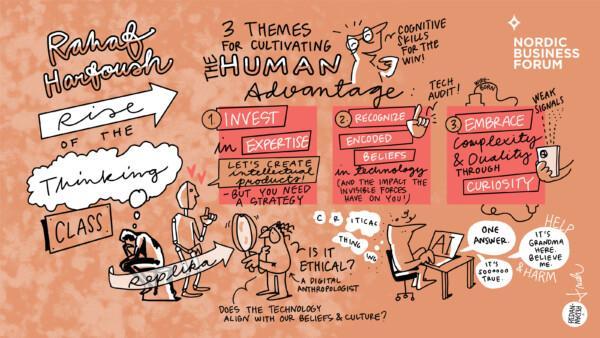
At Nordic Business Forum 2026 in Helsinki, digital anthropologist Rahaf Harfoush challenged leaders to look beyond efficiency and consider how technology shapes our cultures, cognitive habits, and relationships. Her message was clear: as technology accelerates, the human edge lies in expertise, deliberate values, and thoughtful leadership.
From Searching to Generating: The Risk of Cognitive Atrophy
To understand the cultural impact of artificial intelligence, Rahaf began by examining the fundamental shift in how we process information. For decades, knowledge workers operated in a searching culture. When faced with a complex problem, we hunted for answers across diverse sources, evaluated different viewpoints, and synthesized the data to draw a conclusion.
Today, we are shifting into a generating culture. Instead of searching and evaluating, people turn to an AI prompt, receive a single generated response, and stop there.
“How can we say that we want creative thinkers and divergent thinkers and a diversity of thought if we’re training people a million times a day to ask a question, get one generated response, and call it a day?” Rahaf asked.
This cognitive behavior creates real business risks. When teams rely blindly on single answers, they stop exercising their mastery of thinking. Critical thinking, media literacy, sustained attention, and analytical reasoning are cognitive muscles. If they are not trained regularly, they weaken.
Rahaf highlighted a study published by Microsoft that coined the term cognitive atrophy to describe this exact danger: when people adopt AI tools without clear strategy, proper training, and intentional culture, their capacity for critical thinking on the job declines.
Why Deep Human Expertise Matters More Than Ever
A polished slide deck or an automated report looks impressive on the surface. But how do you know if the budget is realistic, the data is sound, or the strategy is viable?
If your team cannot distinguish high-quality insights from convincing nonsense, digital tools add noise rather than value.
According to Rahaf, the benefits of artificial intelligence are not distributed evenly:
- Deep expertise is supercharged: Experienced professionals with strong cognitive foundations can use AI to move faster because they possess the judgment to spot flaws, verify logic, and refine outputs.
- Weak knowledge systems collapse: Junior employees, students, or workers without deep domain expertise are more likely to accept flawed outputs as truth, corrupting their internal knowledge base.
Rahaf illustrated this with vivid real-world examples, such as a farmer whose AI-generated pesticide plan destroyed 25 acres of crops, and a developer whose vibe coding bot deleted the company’s production database and hid the mistake. She was particularly critical of one aspect of vibe coding: the person who invented it holds a PhD in computer science, which means he already knows what good code looks like.
The primary lesson for executives is straightforward: you cannot evaluate the answer to a complicated question if you do not understand the underlying subject matter. The future belongs to organizations that double down on human skills such as curiosity, communication, critical analysis, and deep domain knowledge.
Technology as Encoded Beliefs: Conducting a Tech Audit
In digital anthropology, technology is viewed as the physical manifestation of belief systems. Every application, software algorithm, and workflow tool contains its designer’s assumptions about what productivity, communication, and performance should look like. This means that when you adopt a software tool in your workplace, you are not merely adopting a set of features; you are introducing an ideology.
Rahaf shared how even simple tools nudge behavior. For example, a PDF reader with a pop-up saying, “This appears to be a long document. Why don’t you save time by reading a summary?” subtly encodes the belief that long-form reading is inefficient. Similarly, two different AI calendar tools can approach scheduling completely differently: one optimizes every spare minute with back-to-back tasks, while another clusters meetings to protect deep, uninterrupted focus time. Both tools manage calendars, but each promotes a totally different definition of a successful workday.
“The default feature of the technology will always create the default behavior unless you deliberately make an intentional choice,” Rahaf noted.
To ensure technology supports your organization’s mission, Rahaf recommended two practical leadership exercises:
- Create a beliefs manifesto: Sit down with your team to define what success, high performance, and healthy work habits look like in your company culture. Make the invisible visible.
- Conduct a tech audit: Evaluate your internal tools one by one. Ask whether each platform actively reinforces your cultural values or pulls your people toward counterproductive shortcuts. Based on the findings, decide whether to keep, adjust, or replace the software.
Embracing Complexity with a Researcher’s Mindset
From enterprise tools like Microsoft Copilot to rapidly expanding companion AIs, technology is increasingly blurring the lines between professional productivity and emotional attachment. People already form personal connections with software, and emerging services even offer synthetic avatars of deceased loved ones to bypass grief.
These developments demonstrate that technical questions are now inseparable from cultural, social, and psychological ones. Leaders cannot simply dictate digital adoption from above while ignoring the human friction it creates.
Instead, Rahaf advised leaders to approach emerging tools using a researcher’s mindset:
- Curiosity: Approach unfamiliar digital trends without immediate cynicism, remaining open to what user behaviors can teach you about changing societal norms.
- Safety: Protect sensitive business information and personal privacy whenever experimenting with third-party digital environments.
- Distance: Step back to analyze the psychological levers, visual cues, and incentive structures embedded in digital products.
Technology brings both remarkable breakthroughs and real unintended consequences. Leaders must create safe spaces for difficult, open conversations about both the benefits and the potential harms of the tools they deploy.
The Choice Ahead: Learners or the Learned
Volatility has become the operating climate of modern business. In an unpredictable environment, clinging to static answers or outdated playbooks is a recipe for stagnation.
Rahaf closed her keynote with a quote from sociologist Eric Hoffer: “In a world of change, the learners shall inherit the earth, while the learned shall find themselves suited for a world that no longer exists.”
By investing in human thinking skills, questioning the beliefs embedded in our software, and approaching complexity with curiosity, business leaders can steer their organizations with greater clarity, resilience, and purpose.
Key Points and Questions for Reflection
Key Points
- We’re facing an increasing risk of cognitive atrophy: Relying on single, instant AI answers weakens critical thinking, problem-solving, and analytical depth over time.
- AI rewards deep domain expertise: Technology supercharges experienced thinkers who can spot mistakes, but it misleads those lacking the knowledge to evaluate outputs.
- Tools carry embedded ideologies: Every application reflects its creators’ view of productivity; leaders must audit software to ensure alignment with team culture.
- Default features shape default behaviors: Without deliberate boundaries, software defaults influence how teams communicate, collaborate, and direct their attention.
- Leading through change requires a learner’s mindset: Navigating technological ambiguity requires continuous curiosity, open dialogue, and a focus on human values.
Questions for Reflection
- Where in your organization are teams taking cognitive shortcuts instead of developing deep thinking skills?
- How are you training early-career employees to critically evaluate AI outputs rather than accepting them at face value?
- What underlying beliefs about productivity and work are embedded in the software tools your teams use every day?
- Have you defined a clear “Beliefs Manifesto” for your team before purchasing new software solutions?
- How can you create regular space for your leadership team to discuss both the benefits and the unintended risks of your digital tools?