For years, leaders and organizations have looked at extraordinary achievement through the lens of individual talent and grit. Individual effort undeniably matters. Yet every executive has seen hard-working employees burn out, stumble, or fail to reach their potential despite giving their absolute best.
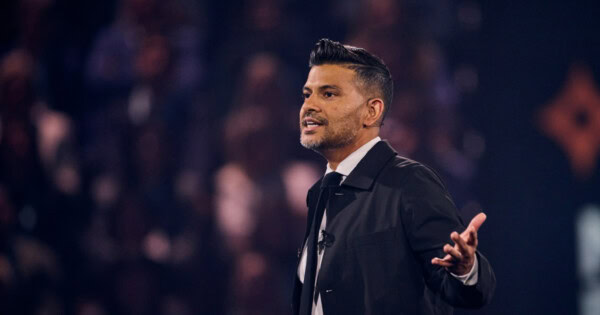
At Nordic Business Forum 2026 in Helsinki, Angela Duckworth offered a broader perspective. A psychologist, professor at the University of Pennsylvania, and author of the bestseller Grit, she has spent decades studying the mechanics of high achievement.
Drawing on her latest research and book, Situated, Angela made the case that grit is essential, but effort pays off far more in some environments than in others. For leaders, that shifts the focus from demanding more grit to creating the conditions that allow people to thrive.
What Is Situational Agency?
To illustrate how different environments alter performance, Angela pointed to the sport of swimming. Michael Phelps is widely considered the most decorated Olympian in history. While his physical gifts and fierce work ethic are legendary, his environment was equally extraordinary. He grew up minutes away from an elite aquatic training center and spent two decades working with renowned coach Bob Bowman. As Michael himself admits, without that specific situation, his athletic story would look completely different.
Most people are not born into the perfect developmental environment. That is where situational agency comes in. Angela defined situational agency as the conscious choice to alter, shape, or change your external circumstances to unlock higher levels of achievement.
Consider French swimmer Léon Marchand. After finishing sixth in the 400-meter individual medley at the Tokyo Olympics, Léon knew he had more potential. Instead of simply swimming more laps in France, he took situational agency. He sent an email to Bob Bowman at Arizona State University, relocated across the Atlantic, trained in world-class facilities, and immersed himself in a culture of high-caliber teammates.
Within two years, Léon shaved more than eight seconds off his best time, shattered Michael Phelps’s final standing world record, and captured Olympic gold in Paris.
His talent did not magically transform overnight. His grit did not suddenly multiply. Rather, he placed himself in a sweet spot where his effort finally had maximum impact.
Why Willpower Fails: The 3 Boxes Model
Many business leaders fall into a predictable trap when results drop. They assume employees simply need to try harder. They preach discipline, demand longer hours, or plead with their staff to show greater resilience.
Modern behavioral science shows that relying on sheer willpower is a losing battle. Willpower is a limited cognitive resource. You cannot force yourself or your staff to push against friction indefinitely without eventually burning out or quitting.
To show how motivation actually operates, Angela introduced the 3 Boxes Model:
- Box 1, Situation: the objective environment, culture, tools, and social circle
- Box 2, Thoughts: internal perceptions and emotional interpretations
- Box 3, Behavior: effort, actions, and performance
Most leadership interventions mistakenly target Box 3 directly through mandates and pressure. Yet what people do in Box 3 is largely shaped by how they think in Box 2.
Through her research, Angela found that top performers consistently hold four beliefs about their daily work: “This work is interesting.” “This work is important.” “I can do this.” “I know what to try next.” When any of these beliefs are absent, motivation fades and performance drops. The leader’s role, then, is to create the conditions in which those beliefs can emerge naturally.
“As a leader, create a situation in which those positive, optimistic thoughts come naturally, which inspires and motivates the behavior that you want.”
Four Practical Ways to Lead with Situational Agency
How can business executives put situational agency into practice across their teams? Angela outlined four concentric elements, ranging from immediate personal spaces to broad organizational cultures.
1. Personal Space: Clear the Immediate 3 Feet
Personal space consists of everything within sight and reach, roughly three feet in every direction. High performers actively arrange this space to support their focus while removing digital friction.
At age 11, Michael Phelps taped a sheet with his Olympic goals right beside his bed so it was the first and last thing he saw every day. Leaders can encourage employees to display clear goals, values, and priority projects within line of sight.
Equally important is clearing distractions. “You have to keep temptations out of sight and out of reach, because out of sight and out of reach means out of mind,” Angela noted.
2. Peers: Build a Community of Strivers
Greatness is almost never achieved alone. When Paul Graham co-founded Y Combinator in 2005, he recognized that launching a startup is too grueling for an isolated founder. Rather than funding individual founders separately, he grouped them into cohorts. That initial batch, which included the early founders of Reddit, Twitch, and OpenAI’s Sam Altman, succeeded largely because they had peers to brainstorm with, keep each other accountable, and offer encouragement when things went sideways.
Within companies, leaders must build genuine tribes where colleagues share knowledge and depend on one another, turning daily accountability into a collective habit.
3. Mentors: Make 5-Minute Connections the Norm
While peers provide horizontal solidarity, mentors provide vertical wisdom. Cognitive scientist Anders Ericsson’s research on expert performance showed that reaching the highest levels requires a teacher who can spot mistakes and guide improvement.
Yet aspiring mentees often make the mistake of asking senior executives to enter a formal mentoring relationship too quickly. Angela noted that asking someone to be your mentor on day one is like proposing marriage on a first date.
Instead, high performers become “mentor magnets” by asking for brief, targeted input. When Oprah Winfrey first approached author Maya Angelou, she promised to take only five minutes of her time. Oprah asked thoughtful questions, listened with care, and thanked Maya the moment five minutes were up, initiating a lifelong relationship.
Angela’s advice to leaders? Lower the barrier to knowledge transfer: “Make five-minute conversations between senior and junior team members the norm.”
4. Culture: Pair High Standards with Deep Care
Culture is simply the way things get done around an organization. When top performers join a company, the collective habits of that workplace quickly become their own.
According to Angela, the most effective organizational cultures mirror high-performing parenting: they balance high challenge with high support. They set an ambitious ceiling for performance while constructing a solid floor of emotional security and resources.
The Compounding Flywheel of Performance
When leaders improve the workplace environment, they trigger a compounding cycle: small, intentional changes to the situation (Box 1) produce healthier thoughts (Box 2), which lead to better behaviors and greater effort (Box 3). As employees experience progress, their confidence grows, enabling them to improve their situation even further.
“I believe you can unleash human potential,” Angela said in closing. “I believe the human edge has so much to do with situational agency and situational leadership.”
The ultimate responsibility of a business leader, then, is not to demand more willpower. It is to follow the advice of swim coach Bob Bowman: step back, look at the big picture, and ask where your people can improve and how you can shape the environment that helps them get there.
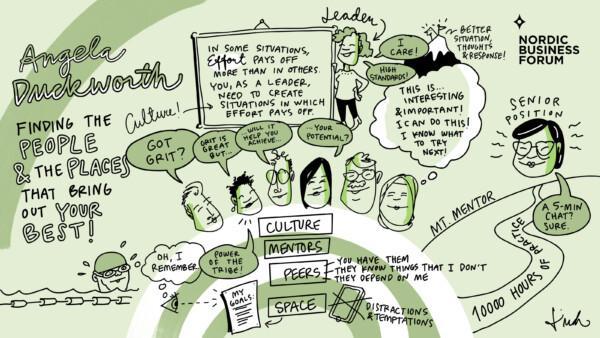
Visual Summary by Linda Saukko-Rauta
Key Points and Questions for Reflection
Key Points
- Grit requires the right context: Individual effort and perseverance are essential, but your environment determines how much that effort actually yields.
- Willpower is an unreliable strategy: Forcing yourself or your team to work harder through pure discipline inevitably leads to exhaustion and diminishing returns.
- The 3 Boxes Model explains human action: Behavior is driven by internal thoughts, and internal thoughts are directly shaped by the external situation.
- Four thoughts fuel engagement: Teams perform at their best when they believe their work is interesting, important, achievable, and clear on next steps.
- Intentional spaces protect deep focus: Organizing the physical 3-foot radius and moving digital temptations out of reach protects precious attention.
Questions for Reflection
- Are you demanding more willpower from your team instead of improving the conditions they work in?
- Looking at your team’s daily environment, what common distractions or procedural hurdles could you remove this week?
- Do your employees feel that their work is both interesting and important, and do they know what step to take next?
- How can you help junior team members initiate low-pressure, five-minute learning conversations with senior mentors?
- Does your organization provide the high support required to meet your high performance expectations?