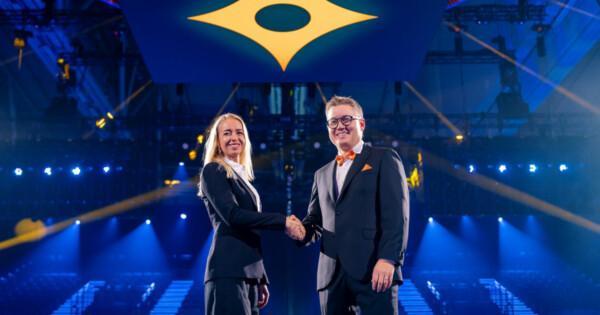
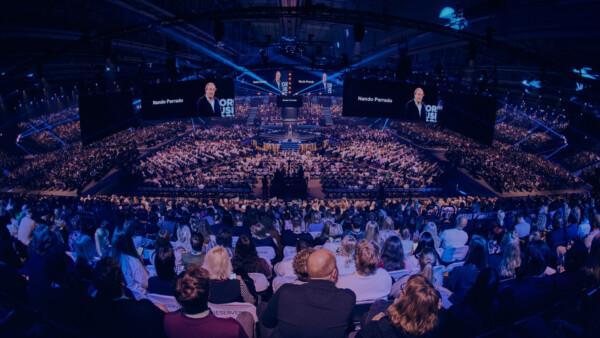
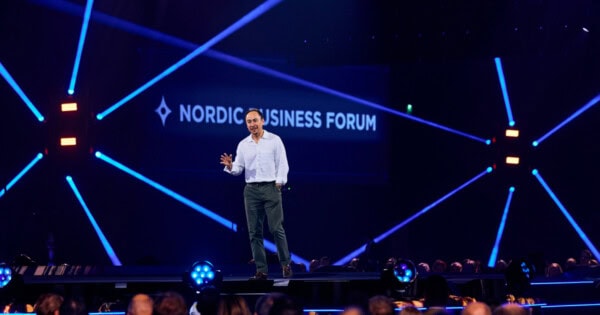
Yesterday’s Executive Summit in Helsinki brought together a group of CEOs executives around one of the defining leadership questions of our time: how can organizations remain competitive in a world shaped by uncertainty, technological acceleration, and geopolitical fragmentation?
During the event we enjoyed keynote presentations by Stéphane Garelli, Founder of the IMD World Competitiveness Centre, and Mårten Mickos, serial CEO, followed by an executive dialogue joined by Sanna Suvanto-Harsaae, experienced COB, and moderated by our co-founder Hans-Peter Siefen.
Throughout the evening, one insight came up repeatedly: the future will not belong to the organizations that simply try to preserve the old model a little longer. It will belong to those capable of adapting quickly, focusing clearly, and leading courageously.
Stéphane Garelli: The New World of Competitiveness in 2026 and Beyond
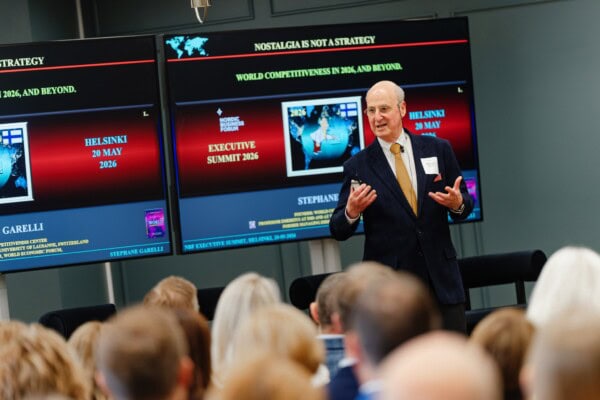
Stéphane Garelli opened the evening with a sweeping look at the global economy and the forces reshaping competitiveness around the world.
At the heart of his keynote was the argument that many leaders are still trying to operate according to assumptions that no longer hold true. The world that shaped business thinking for the last forty years — an era of globalization, expanding markets, and increasing efficiency — has fundamentally changed.
“The real difficulty lies not in developing new ideas, but actually in escaping from the old ones.”
Referencing John Maynard Keynes, Stéphane reminded the audience that innovation is not really the problem – we struggle more on being stuck with past success. The challenge for today’s leaders is not simply to react to change, but to accept that the operating environment itself has permanently shifted.
He described today’s economy as deeply contradictory. Technological innovation is accelerating, yet productivity growth remains sluggish. Enormous amounts of capital exist globally, yet investment confidence remains fragile. Economies recover, but many citizens feel increasingly disconnected from growth and opportunity.
For Stéphane, these contradictions are signs that leaders can no longer rely on old frameworks to explain the world around them. Competitiveness is becoming less about scale and optimization, and more about adaptability, resilience, and speed of learning.
Europe’s position in the global economy became a major topic throughout his presentation. Stéphane warned that Europe risks losing ground if it cannot reduce fragmentation, simplify regulation, and accelerate innovation. Yet he also resisted overly pessimistic narratives. Smaller countries and organizations can still compete effectively, he argued, provided they remain agile and capable of moving faster than larger systems burdened by bureaucracy and inertia.
His keynote ultimately became a call for realism rather than nostalgia. Stability is unlikely to return in the form many leaders remember. Instead of waiting for certainty, organizations must build the capability to perform amid continuous disruption.
Mårten Mickos: Leadership, Technology, and Trust in the AI Era
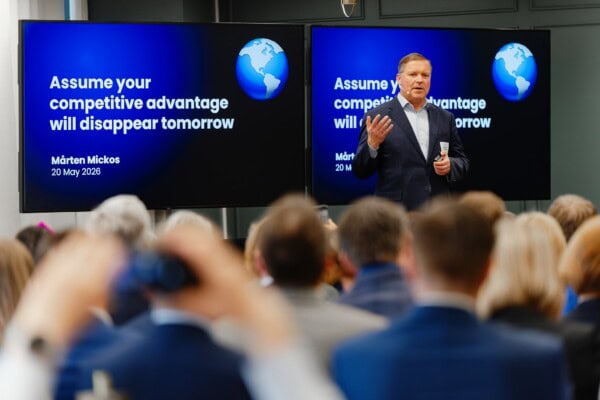
Where Stéphane focused on macroeconomic transformation, Mårten Mickos approached competitiveness from the perspective of leadership, organizational culture, and technology. His keynote centered on a timely question: as AI rapidly transforms the business landscape, what will still separate great organizations from mediocre ones?
For Mårten, the answer is not technology itself. Technology may become widely accessible, but leadership quality, trust, and organizational culture remain difficult to replicate.
He argued that many organizations make the mistake of treating AI primarily as a technical challenge. In reality, its greatest impact may be cultural. Companies will need to rethink how decisions are made, how quickly teams can adapt, and how leaders create environments where experimentation is encouraged rather than feared.
“When things are changing, then we have to switch to wartime leadership.”
Mårten emphasized that speed is becoming one of the defining competitive advantages of modern organizations. In times of uncertainty, leaders must shift from “peacetime leadership” to what he called “wartime leadership” — a model built around continuous experimentation, faster execution, quicker decision-making, and a greater willingness to act without perfect information. Organizations that adapt and learn continuously will outperform those that spend too much time deliberating or waiting for certainty. The goal is to have the ability to accelerate when circumstances demand it and slow down again when stability returns.
At the same time, Mårten underlined that agility cannot exist without trust. Teams move faster when people feel safe sharing ideas, challenging assumptions, and acknowledging mistakes openly. Without trust, organizations become slower, more political, and less innovative.
One of the core ideas in Mårten’s keynote was the reminder that even in an AI-driven future, competitiveness remains fundamentally human. Curiosity, empathy, courage, communication, and collaboration continue to matter deeply — maybe even more than before. Technology may reshape workflows and business models, but it does not eliminate the need for strong leadership. In many ways, it amplifies it.
Executive Dialogue: Competitiveness, Crisis Readiness, and Leadership Under Pressure
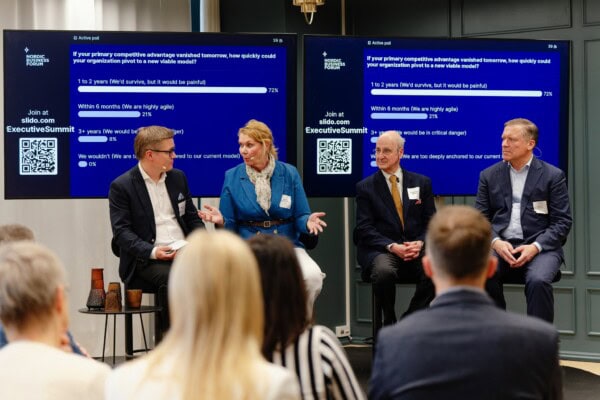
The evening concluded with a conversation between Stéphane Garelli, Mårten Mickos, and Sanna Suvanto-Harsaae, moderated by Hans-Peter Siefen.
A recurring theme throughout the conversation was how organizations respond when uncertainty becomes constant rather than temporary. The panel discussed whether companies today are truly capable of adapting fast enough when their competitive advantage suddenly disappears, and whether many leaders still underestimate the speed at which markets can shift.
Drawing from her experience at Finnair during COVID and the closure of Russian airspace, Sanna emphasized the importance of building organizational readiness before a crisis arrives. Companies that had actively trained scenario planning capabilities beforehand were able to react significantly faster once circumstances changed.
“You have to have a muscle which is about scenario management.” — Sanna Suvanto-Harsaae
When talking about how to spot a threat to your competitiveness, Mårten also advised leaders to listen to the non-obvious voices. For example, you can do customer service yourself and you see what customers are complaining about. You can also speak to an underserved market, or speak to your future customers — those can be ways for you to anticipate a change coming.
While the discussion highlighted the need for speed and adabtability, Stéphane reminded the audience that organizations cannot operate in constant instability alone. While business models and markets may change rapidly, successful companies still need a stable foundation built on culture, values, and trust.
The panel also reflected on one of the greatest risks facing successful organizations: complacency. As Garelli noted, many companies fail not because they lack capability, but because they fail to recognize how quickly the world around them is changing.
“Arrogance and complacency have killed more companies than any strategic mistakes.” – Stéphane Garelli
Despite the challenges discussed throughout the evening, the conversation ultimately remained optimistic. Crises, the speakers suggested, can also become catalysts for renewal — but it requires organizations to be prepared to respond decisively, adapt quickly, and embrace change rather than resist it.
Competitiveness in the Age of Change
The evening left participants with a powerful reminder that competitiveness is no longer a static advantage. It’s a moving target shaped by continuous change.
Across all three sessions, several themes stood out clearly. The organizations best positioned for the future will be those capable of adapting quickly, learning from failure, building trust intentionally, and combining technological capability with deeply human leadership.
In a world where disruption has become permanent, competitiveness may ultimately come down to one question: how quickly can organizations learn, evolve, and move forward together?