What makes a leader truly great in a world where everything is changing fast?
Angela Ahrendts has a few answers. And they come not from theory, but from practice. As the former CEO of Burberry and SVP of Apple Retail, she has shaped some of the world’s most iconic brands through deep purpose, bold decisions, and a relentless focus on the human side of leadership.
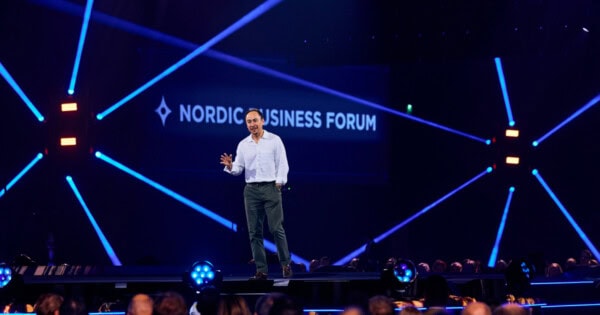
At Nordic Business Forum 2025, Angela shared the defining moments of her journey, spanning from sewing clothes as a child in small-town Indiana to leading 70,000 Apple employees across 27 countries. Through it all, one message was clear: business transformation is only possible when leaders lead with heart.
Leading with Humanity
Angela didn’t open with a playbook or a framework. She began with a story. Growing up in a family of six, she learned early how to find her place, how to compete, and how to care. “People are incredible,” she said. “When you get a lot of ordinary people together and get them focused, they can do extraordinary things.”
That philosophy followed her throughout her career, from early retail jobs to the global boardrooms of Apple and Burberry. While her resume includes billion-dollar turnarounds, Fortune magazine covers, and digital innovation milestones, she insisted that her most powerful leadership moments were also her most vulnerable ones.
“Some of my best leadership moments were when I was the most vulnerable.”
One example is when, in a time of market crashes and internal chaos, Angela once cried in front of her team. She worried it showed weakness. Instead, it showed how deeply she cared. Her people leaned in.
Reinventing Legacy: The Burberry Playbook
When Angela took over as CEO of Burberry, the 150-year-old fashion house had just £30 million left in the bank. But she didn’t jump into a flashy turnaround plan. She started with a question: Why did Thomas Burberry start this company?
His original mission was to protect explorers by producing clothing with functional, innovative fabrics. Angela used that purpose as a thread to reconnect the brand to its roots while preparing it for a digital-first future.
She made bold calls, such as focusing on outerwear, targeting a younger customer, and shifting from wholesale to direct-to-consumer. Perhaps most disruptive of all, she declared that Burberry would become the first digital luxury brand.
This was at the very start of the iPhone era. Twitter hadn’t launched. But Angela saw what was coming and outlined a new strategy: “We said we’re going digital first. We’re going younger. If it didn’t go through that lens, it had to go away.”
By realigning the company’s heritage with a modern vision and bringing employees into every step of the strategy, Angela helped double Burberry’s business faster than expected.
From Fashion to Tech: The Apple Shift
In 2014, Angela surprised many by leaving Burberry to join Apple. At the time, she resisted the offer, and even declined it several times. But a conversation with Tim Cook changed everything. “Two minutes after I sat down, Tim looked at me and said, ‘You know you’re supposed to be here’”, she recalled.
At Apple, Angela was tasked with transforming the retail experience for over a billion customers per year. The mission wasn’t just to sell devices. It was to make stores into community spaces, places where people could learn, connect, and explore creativity.
This led to the launch of “Today at Apple,” an in-store initiative offering 80,000 free sessions per week around the world.
Internally, she crowdsourced ideas from 50,000 employees to reimagine the entire experience. She brought in a small firm to collect anonymous feedback and used it to inform every major decision.
Angela didn’t see Apple Retail as just a store. She saw it as part of a 3D, 2D, and 4D ecosystem: physical, digital, and mobile, all connected and consistent. Her mantra? “Apple Retail must be where the best of Apple comes together.”
The AI Revolution Is Human
Angela didn’t shy away from the topic of artificial intelligence. In fact, she embraced it. To her, AI isn’t a threat. It’s an equalizer. A catalyst for rethinking how businesses operate, how leaders lead, and how teams collaborate.
She urged leaders to stop building traditional hierarchies where all tech decisions flow through a single executive or department. Instead, companies should empower young, AI-native employees in every function to experiment and drive innovation from within. In her own words: “The hierarchy won’t work anymore. You need these young AI natives in every department.”
A key question in this new era is what separates good leaders from great ones. Angela believes it comes down to human traits: empathy, curiosity, compassion, and vulnerability. And above all, the ability to guide people through change with clarity and care.
“People want to be led. They want to know where they’re going.”
Values, Legacy, and Looking Back
Whether at Burberry, Apple, or now on the board of Airbnb, Angela holds on to one principle: “You’re only there ten years or so, and then you pass the baton on to the next generation,” she said.
In closing, she reminded the audience that great leaders don’t just drive short-term results. They preserve the integrity of the brand and prepare it for the next chapter.
That’s why she’s guided by Steve Jobs’ famous quote: “You can’t connect the dots looking forward. You can only connect them looking backward.”
And when you look back at Angela Ahrendts’ career, from Indiana to London to Cupertino, the dots form a clear path. One shaped not just by strategy or success, but by purpose, people, and the quiet power of staying human in everything you do.

Key Points and Questions for Reflection
Key Points:
- Transformation begins with purpose. Angela reconnected both Burberry and Apple to their core mission before moving forward.
- Involve your people. She crowdsourced strategies from thousands of employees to co-create change.
- Vulnerability is a strength. Her most impactful moments as a leader came when she was open and real.
- AI is an opportunity. She encourages reverse mentoring to bring younger digital natives into decision-making.
- Legacy matters. Every leader is a steward of the brand during their tenure. The goal is to build for the next generation.
Questions for Reflection:
- Are you leading with empathy and vulnerability, or just strategy and performance?
- How connected are your employees to your company’s purpose?
- What legacy are you leaving behind, and will it serve the next generation?
- Are you tapping into the creative potential of your youngest team members?
- How are you preparing your company to adapt in a world increasingly shaped by AI?